How to Identify a Striped Bass vs a White Perch in Maryland
Many Maryland anglers, especially newcomers or those fishing a new body of water, often find themselves scratching their heads when trying to differentiate between a Striped Bass and a White Perch. While both are iconic Maryland fish and belong to the same family, mixing them up can lead to confusion, especially with juveniles, and potentially impact adherence to specific fishing regulations. This guide will meticulously break down the distinguishing features, behaviors, and habitats of both species, ensuring you can confidently tell a Striped Bass from a White Perch on your next outing.
The Root of the Confusion: Why Anglers Mix Them Up
It's completely understandable why these two species get confused, particularly by those just starting out or by anglers who haven't spent much time focusing on their distinct characteristics. They share some superficial traits that, at a quick glance, can be quite misleading.
Shared Superficial Similarities
Both Striped Bass (affectionately known as rockfish in Maryland) and White Perch are often found in the same waters, particularly in the brackish rivers and upper Chesapeake Bay. They share a generally silvery, somewhat elongated body shape, especially when they're young. This initial visual can often be the source of the mix-up.
Think about fishing a productive dock in a tidal creek on the Eastern Shore or even a lively spot in the lower Susquehanna River. You'll likely encounter both species. When you're reeling in a feisty fish, the initial flash of silver and the characteristic fight can feel quite similar, leading to that moment of "Is this a striper or a perch?" before you get a closer look. This initial impression can be especially misleading with smaller, juvenile fish, where the defining features haven't fully developed or are harder to discern quickly. The common coloration and similar energetic fight contribute to this first-blush confusion.
Their schooling behavior also contributes to the confusion. Both species often congregate in schools, chasing baitfish. When you're experiencing a hot bite, with fish hitting your lure one after another, it's easy to just assume they're all the same until you take a moment to really examine your catch. This quick pace of action can blur the lines of identification, especially if you're using bait or lures that appeal to both, such as small soft plastics or shiny spoons.
The Juvenile Delinquents of Identification
The most significant overlap in appearance occurs when both species are young. A 6-inch Striped Bass might, at first glance, look quite a bit like a larger White Perch. The definitive stripes that are so prominent on a mature Striped Bass can be less defined or even somewhat faint on very young individuals, making the distinction harder. This is where the casual observer can easily be fooled.
Consider a situation where you're targeting white perch in a shallow creek, perhaps near Fishing the Choptank River, and suddenly, you hook a fish that feels a bit stronger than the usual perch. If it's a juvenile striped bass, its size might fall within the range you'd expect for a larger perch, and its markings might not yet scream "striper!" This is where knowing the subtle differences becomes crucial, not just for identification but also for adhering to Maryland Fishing Size and Catch Limits by Species. Without careful attention to detail, a small striper could easily be mistaken for a trophy perch, leading to unintended regulatory issues.
Decoding the Striped Bass: Distinctive Features
When it comes to the Striped Bass, there are several unmistakable features that, once you know what to look for, make identification straightforward. These are truly impressive fish, and their appearance reflects their powerful, predatory nature.
The Bold and Unbroken Stripes
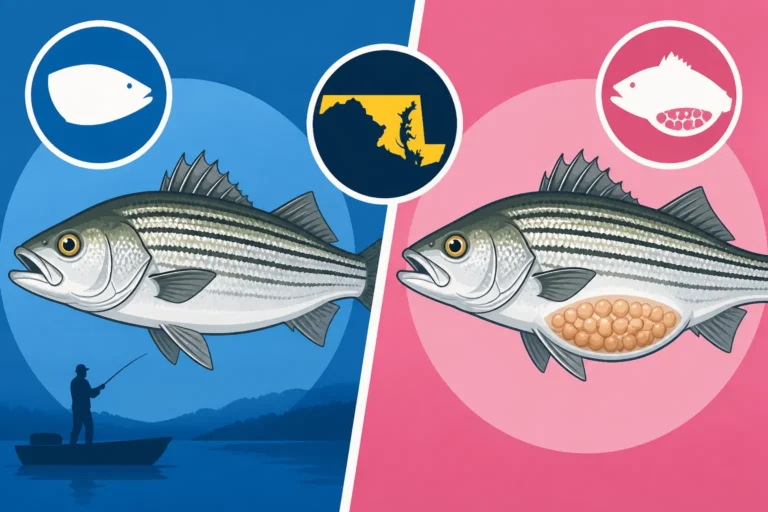
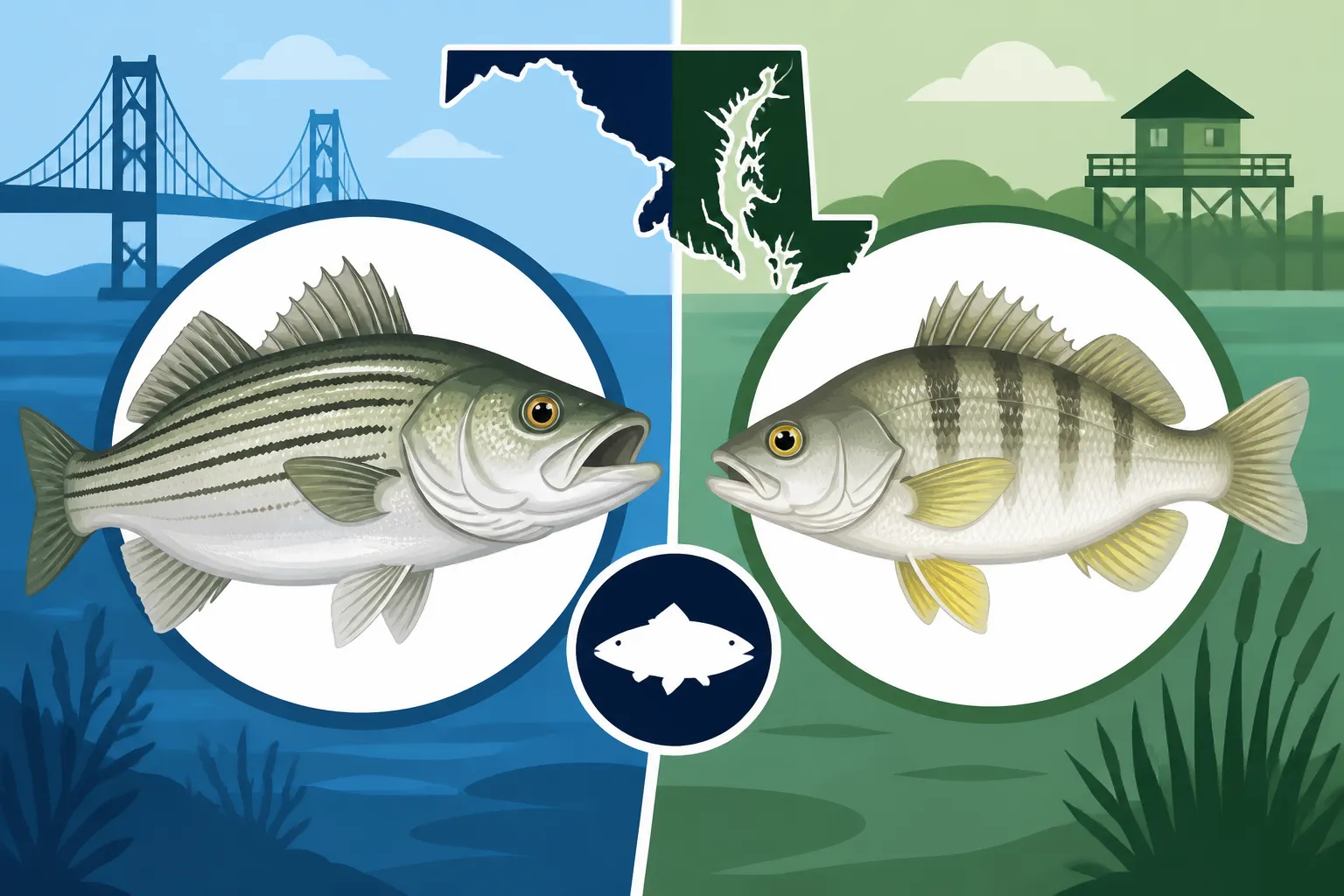
The most iconic feature of the Striped Bass, or rockfish as they're lovingly called here in Maryland, is their prominent horizontal stripes. These stripes are typically dark, well-defined, and run from behind the gill plate all the way to the tail. What's crucial here is that most of these stripes, especially the ones above the lateral line, will be unbroken. They're solid lines, not a series of dots or broken segments. This continuous nature is the hallmark of a true Striped Bass.
Imagine holding a lively 20-inch striper in your hands. You'll immediately notice the bold, almost painted-on lines. There are usually 7 to 8 of these stripes, with some running parallel to each other. If you run your finger along one, you'll feel it's a continuous line of coloration. This unbroken nature of the stripes is your number one visual cue, a clear giveaway that you've got a true rockfish. Even if a few of the lower stripes might seem a bit fragmented, the dominant, central stripes will nearly always be solid.
Sometimes, particularly on very large or very small stripers, one or two of the lower stripes might appear slightly broken or faint, but the majority, especially the central ones, will remain solid. Always look for that consistent, uninterrupted line pattern to confirm your catch. It’s an essential detail for proper Maryland Striped Bass Season and Rockfish Rules adherence, as regulations can be quite strict for this prized gamefish. You can often spot these distinctive stripes even in murky water if the light catches the fish right.
Head, Mouth, and Body Shape
Striped Bass possess a more elongated, streamlined body shape, built for power and speed in open water. Their body tapers gracefully from head to tail, giving them a hydrodynamic profile that allows for swift pursuit of prey. This sleek build is distinct from the more compact body of a perch.
Their head is relatively large in proportion to their body, and their mouth is terminal (meaning it opens at the very front of the snout) and quite sizable. You'll notice that the lower jaw often protrudes slightly beyond the upper jaw, giving them a determined, predatory look. This large, powerful mouth is perfectly adapted for engulfing baitfish like menhaden or silversides whole, a clear indicator of their predatory lifestyle. Examining the head and mouth is often the quickest way to confirm a Striped Bass, especially when dealing with smaller individuals where stripe clarity might be ambiguous.
Another key detail is the presence of two distinct dorsal fins. The first is spiny, and the second is soft-rayed, separated by a noticeable gap. The anal fin has three sharp spines at its front, giving it a sturdy, angular appearance. These fin characteristics, combined with the elongated body shape and the large, projecting jaw, paint a clear picture of a Striped Bass. A good fish identification guide, perhaps one you ordered from Amazon, will typically highlight these specific anatomical traits.
Understanding the White Perch: Subtle Distinctions
While related to the Striped Bass, the White Perch has its own set of characteristics that, once learned, make it easy to distinguish. These fish are feisty and abundant, offering great light-tackle action across Maryland's diverse waters.
Fainter Stripes and More Compact Body
White Perch, while also silvery and possessing stripes, display them much more subtly. Their stripes, if visible, are usually lighter, often faint, and frequently appear as broken lines or rows of dusky spots, particularly on older or larger specimens. They might even seem to disappear entirely on some individuals, especially if the fish has been stressed or is in certain water conditions, such as murky water or shaded areas.
Picture a bucket full of freshly caught white perch from the Severn River, perhaps near Fishing the Severn River Near Annapolis. You'll see their general silver sheen, but when you look for stripes, you'll notice they aren't as defined or continuous as those on a rockfish. Instead, you might see vague, horizontal smudges or interrupted dashes of darker pigment that don't form clear, solid lines. The overall impression is less "striped" and more "silvery with faint markings" that sometimes look more like a diffuse shadow than a distinct line.
The body of a White Perch is also noticeably deeper and more compact than a Striped Bass, giving it a more "stubby" or "stocky" appearance. It's not as torpedo-shaped as its larger cousin; rather, it's built for navigating tighter spaces and ambush feeding in structure-rich environments. This compact build, often with a higher arch to its back, is often a dead giveaway, even from a distance, making them appear almost rounder in profile compared to the long, slender striper.
Smaller Mouth, Rounded Profile
Unlike the large, protruding jaw of the Striped Bass, the White Perch has a much smaller, more terminal mouth that doesn't extend as far back. The jaws are more even, and the overall head profile is rounder and less angular. This smaller mouth is perfectly adapted for feeding on smaller prey items like insects, crustaceans, and small minnows, rather than large baitfish. You won't see that aggressive, under-slung jaw that characterizes the striper.
When you compare the heads side-by-side, the White Perch's head will appear proportionally smaller to its body. Its eyes might also seem a bit larger in relation to its head size compared to a striper. These features, though subtle, are incredibly consistent across the species and serve as reliable indicators. The lack of that prominent, gaping maw is a key visual cue that often confirms you're looking at a perch.
The White Perch also has two dorsal fins, but they are typically connected at the base or very closely adjoined, not widely separated like the Striped Bass. The anal fin, like the striper, has three spines, but the fin itself is often a bit smaller and more rounded in profile. These fin attachments are a key characteristic to observe when differentiating the two, as they present a stark contrast to the separated dorsal fins of the Striped Bass.
Habitat, Diet, and Behavior: More Clues for Identification
Beyond physical appearance, where and how these fish live and feed can provide strong hints about which species you've encountered. Understanding their ecological niches often clarifies identification even before you get a close look.
Preferred Environments and Water Types
Striped Bass are primarily anadromous fish, meaning they spend most of their lives in saltwater or brackish estuaries, returning to freshwater rivers to spawn. This means you'll find them predominantly in the main stem of the Chesapeake Bay, its larger tidal tributaries, and along the coast. While they do enter freshwater rivers, it's typically for spawning or during migrations, and they generally prefer water with at least some salinity.
If you're fishing the middle or lower Chesapeake Bay, say near Solomons Island and the Patuxent Mouth or out in the Atlantic Ocean near Ocean City Maryland Fishing Guide, almost any fish resembling a striped fish will likely be a Striped Bass. They thrive in those expansive, open-water environments, often found around deeper channels, ledges, and structure like the Bay Bridge pilings. However, juveniles might venture further up into fresher tributaries, blurring the lines a bit, which is why visual cues remain so important.
White Perch, on the other hand, are much more adaptable. They are incredibly versatile and can thrive in purely freshwater lakes and ponds, brackish rivers, and even moderately salty bay waters. You'll find them in tidal creeks, major rivers like the Choptank or Patuxent, and reservoirs like Loch Raven. Their versatility means they can be encountered in a far wider range of habitats across Maryland, from the mountain lakes of Western Maryland to the shallow flats of the Eastern Shore. If you're fishing a small, non-tidal freshwater lake in central Maryland, and you catch a small, silvery, striped fish, it's almost certainly a White Perch. While stripers can be found in some freshwater impoundments (often stocked hybrids), native White Perch are a much more common freshwater resident. This habitat preference offers a good initial filtering question for identification, providing a strong geographical clue.
Feeding Strategies and Prey
Striped Bass are opportunistic and voracious predators. Their diet consists mainly of larger baitfish such as menhaden, herring, silversides, and eels. They are known for aggressive feeding frenzies, often herding baitfish against the surface or into shallow areas, making them spectacular targets for anglers using lures that mimic baitfish. Their large, powerful mouths are perfectly adapted for these larger prey items.
When you see schools of fish crashing the surface, with gulls diving and a general commotion, it's a classic sign of Striped Bass on the hunt. Their large mouths and powerful bodies are designed for chasing down and engulfing larger prey, often in open water. They're apex predators in their ecosystem, a fact reflected in their diet and their aggressive take on many different types of lures, from large plugs and swimbaits to heavy jigs. Knowing What Do Striped Bass Eat in the Chesapeake Bay? can help you understand their behavior and anticipate their presence.
White Perch, while also predatory, have a more varied and generally smaller diet. They consume insects, insect larvae, small crustaceans (like grass shrimp and small crabs), worms, and very small baitfish. Their smaller mouths are perfectly adapted for picking off these smaller food items, often foraging along the bottom or near structure. They are also adept at bottom feeding, scavenging for morsels rather than actively chasing large schools of baitfish.
If you're catching fish consistently on small soft plastics, tiny jigs, or bits of bloodworm fished on the bottom in a tidal creek, chances are high you're dealing with White Perch. They don't typically engage in the dramatic surface busting activity associated with Striped Bass, preferring to hunt in ambush among structure or forage along the bottom. This difference in feeding behavior is another strong clue; if you're using small bait and catching a small, silvery fish, it's a good bet it's a perch.
Size, Age, and Growth: The Scale of Distinction
One of the most immediate and telling differences between a Striped Bass and a White Perch is their potential size and how they grow throughout their lives. This factor alone can often resolve any identification doubts.
Max Size and Lifespan Differences
This is perhaps the most significant difference when considering the potential for confusion. Striped Bass are true giants compared to White Perch. They can grow to impressive sizes, easily exceeding 50 pounds and reaching lengths of well over 4 feet. A trophy Striped Bass is a fish of a lifetime, a testament to its long life and incredible growth potential. Maryland is famous for its trophy rockfish opportunities, particularly during the spring and fall seasons.
The typical "keeper" Striped Bass in Maryland waters often falls in the 18-35 inch range, but much larger specimens are certainly caught, especially during the spring and fall migrations. These fish can live for 20-30 years or even longer, steadily growing throughout their lives. When you're talking about a fish that could potentially be as long as you are tall, there's little doubt it's a Striped Bass. This vast difference in maximum size is a critical indicator; you simply won't find a White Perch that rivals even a modest-sized striper.
White Perch, while fun to catch, are much smaller. They rarely exceed 10-12 inches and a pound in weight, though a "slab" white perch of 14-15 inches is considered an exceptional catch and a true trophy for the species. Most anglers consider anything over 9 or 10 inches to be a fantastic eating size. They typically live for 5-10 years, reaching their maximum size much faster than their larger cousins and then maintaining it.
If you're consistently catching fish that are all roughly the size of your hand to forearm, you're almost certainly targeting White Perch. It's extremely rare to find a White Perch that would even come close to the minimum legal size of a Striped Bass, illustrating the stark difference in their growth potential. This is a clear indicator that helps separate the two species once they've reached a certain size.
Growth Rates and Angler Experience
Striped Bass have a relatively fast growth rate, especially in their early years, which is why juvenile stripers can sometimes be mistaken for larger perch. However, they continue to grow significantly year after year, adding inches and pounds to their frame. This sustained growth is what allows them to reach such impressive dimensions and become the powerful fighters they are known to be.
For anglers, this means that even a "small" Striped Bass might feel like a substantial catch, pulling hard and fighting valiantly. The sheer power of a striper, even a juvenile, often surprises those accustomed to catching only smaller species. This power is a direct result of their growth potential and robust physiology, making them exhilarating to hook on lighter tackle.
White Perch, while also growing quickly in their youth, plateau much sooner. They reach their adult size relatively quickly and then spend the rest of their lives maintaining that size or growing very slowly. Their fight, while spirited, is generally not as powerful or prolonged as a Striped Bass of similar length, simply because the Perch isn't built for that sustained power. They're more about quick, sharp tugs than long, tearing runs.
An experienced angler can often tell the difference between the two species just by the way they fight. A Striped Bass will often make long, powerful runs, shaking its head vigorously, giving a heavy, thumping sensation. A White Perch, while feisty, tends to make shorter, more erratic pulls, and often doesn't have the brute strength to peel line off a reel in the same way. This "feel" on the rod is a subtle, but reliable, clue that comes with time on the water.
Regulatory Implications: Why It Matters to Know the Difference
Beyond simply knowing what you've caught, correctly identifying these two species is critical for staying within the bounds of Maryland's fishing laws. The regulations for Striped Bass are significantly more complex and stringent than for White Perch.
Size and Creel Limits
Maryland has very specific and often changing regulations for Striped Bass, including minimum and maximum size limits (often referred to as slot limits), daily possession limits, and sometimes even maximum boat limits. These rules are in place to protect the fishery and ensure sustainable populations of Striped Bass: Maryland's State Fish. Failing to correctly identify a Striped Bass can lead to serious consequences if you inadvertently keep an undersized or oversized fish, or exceed your daily limit. These penalties can range from significant fines to license suspension.
For example, if you're fishing during a season with a particular slot limit for Striped Bass, such as the 19 to 24 inches explained by Maryland Rockfish Slot Limit Explained, a misidentified juvenile striper that's actually below the minimum size could put you in a tough spot with enforcement. Similarly, keeping a "trophy" striped bass might only be allowed during specific periods and within certain size ranges. Always consult the Maryland DNR fishing guide, or check reliable online resources before you head out, and keep a tape measure handy.
White Perch, on the other hand, typically have much more liberal regulations. In many Maryland waters, there is no minimum size limit, and the daily creel limit is often generous, allowing anglers to keep a good number for a meal. This difference in regulation underscores the importance of correct identification. You might keep 20 white perch for a delicious fry-up, but keeping 20 striped bass, even small ones, would almost certainly put you in violation of strict state laws designed to protect this keystone species.
Seasonal Restrictions and Gear Requirements
Striped Bass are subject to complex seasonal closures, including specific spawning river closures and periods when targeting them is prohibited, or when only catch-and-release is permitted. For instance, Maryland Spawning River Closures for Striped Bass are critical times when you must avoid targeting them, even if you intend to release them, to protect vulnerable spawning aggregations. There can also be specific gear requirements, such as mandating the use of circle hooks when fishing with natural bait for Striped Bass, a rule designed to increase survival rates of released fish.
Imagine you're fishing in a river during a spring spawning closure, and you hook what you think is a large white perch, only to discover it's an undersized striped bass. Even if you release it, simply targeting them during a closure could be a violation. These regulations are designed to protect vulnerable spawning populations, and knowing your fish is paramount for compliance and conservation.
White Perch generally face far fewer seasonal restrictions. They can typically be fished for year-round in most Maryland waters, and gear requirements are usually less stringent, allowing for a wider variety of tackle and methods. This flexibility makes them a popular target when other species, like Striped Bass, are under tighter management or seasonal closures. For an angler, knowing these differences means you can pivot your fishing strategy to target what's open and legal, making the most of your time on the water and avoiding potential legal issues.
Quick Reference: A Side-by-Side Comparison
To make things even clearer, here's a handy table summarizing the key differences between Striped Bass and White Perch in Maryland:
| Feature | Striped Bass (Rockfish) | White Perch |
|---|---|---|
| Body Shape | Elongated, torpedo-shaped, more streamlined | Deeper body, more compact, stockier |
| Stripes | 7-8 dark, bold, unbroken horizontal stripes | Fainter, often broken or dusky horizontal lines/spots |
| Head/Mouth | Larger head, large terminal mouth, lower jaw protrudes | Smaller head, smaller terminal mouth, jaws more even |
| Dorsal Fins | Two distinct fins, clearly separated by a gap | Two fins, often connected or very closely adjoined |
| Maximum Size | Can exceed 50 lbs and 4 ft (common keepers 18-35 inches) | Rarely exceeds 2 lbs and 15 inches (common keepers 7-10 inches) |
| Typical Habitat | Primarily tidal rivers, Chesapeake Bay, ocean (brackish/salt) | Highly adaptable; freshwater lakes, ponds, brackish rivers, Bay |
| Primary Diet | Larger baitfish (menhaden, herring, eels) | Insects, crustaceans, worms, small minnows |
| Regulations | Strict size/creel limits, seasonal closures, gear rules | Often generous creel limits, few or no size limits, year-round seasons |
Ensuring You Get It Right Every Time
Even with all this information, sometimes on the water, things can still be a bit tricky. But with a little practice and the right approach, you can become a confident identifier of Maryland's fantastic fish species.
Practice and Observation are Key
Like any skill, identifying fish accurately comes with practice. The more you fish and the more closely you observe your catches, the faster and more confident you'll become in telling a Striped Bass from a White Perch. Don't be afraid to take a moment to examine a fish before releasing it or placing it in your cooler. Every fish you catch is an opportunity to sharpen your identification skills.
Carry a small waterproof fish identification guide or even a laminated printout of key characteristics in your tackle box. Many reputable tackle shops, or online retailers like Amazon, offer these handy tools that can serve as quick references. If you're fishing with more experienced anglers, ask them to point out the differences when you catch a fish. Their firsthand knowledge and ability to highlight subtle nuances can be invaluable, especially when you're just starting to learn.
When in doubt, it's always better to err on the side of caution. If you're genuinely unsure if a fish is a Striped Bass or a White Perch, treat it as the species with the stricter regulations. For instance, if you're not positive, assume it's a Striped Bass and release it if it doesn't meet the current size limits, or if you're in a closed area for that species. This cautious approach helps protect the fishery and keeps you on the right side of the law, which is especially wise given the varying rules for Maryland Chesapeake Bay Sport Fishing License Explained.
Gear Choices and Targeting Specific Species
Often, the gear you choose can also give you a strong hint about what you're likely to catch. If you're throwing larger plugs, heavy jigs, or big chunks of cut bait, you're primarily targeting Striped Bass. While a large White Perch might occasionally hit a bigger lure, it's not their usual fare, as their mouths are simply too small to effectively engulf such offerings. This selective targeting can help narrow down your expected catch.
Conversely, if you're using ultra-light tackle, tiny jigs, small spinners, or fishing with bloodworms or grass shrimp on light bottom rigs, you're almost certainly going to be catching mostly White Perch. This is the classic setup for these feisty panfish, as it matches their smaller mouth size and preferred diet. Understanding what fish are typically caught with certain Maryland Fishing License for Non-Boat Anglers methods can help you prepare your tackle and expectations accordingly.
Of course, fishing is full of surprises! You might be jigging for Striped Bass and hook into a monster White Perch, or vice versa. But by understanding the primary differences in appearance, habitat, diet, and typical size, you'll be well-equipped to make an accurate identification every time. Remember, the goal is not just to catch fish, but to understand them and respect the regulations that keep Maryland's fisheries healthy for generations to come. Having a variety of tackle, perhaps some versatile spinning reels from Amazon, can allow you to switch targets if needed.
Disclaimer
This article is for general informational purposes only and does not constitute professional advice. Laws, prices and regulations vary by location and change over time. Consult a qualified professional for guidance on your specific situation.