Flathead Catfish vs Blue Catfish, How to Tell Them Apart
One of the most common head-scratchers for anglers in Maryland, especially those venturing into our prolific catfish waters, is telling the difference between a Flathead Catfish and a Blue Catfish. It’s not just about curiosity; correctly identifying your catch can impact everything from adhering to regulations to understanding the best fishing techniques. This guide is here to clear up the confusion, giving you the definitive pointers to confidently tell these powerful fish apart the moment they hit your net.
The Challenge of Catfish Identification in Maryland Waters
You're out on the water, maybe the Potomac or a quiet stretch of the Choptank, and you hook into a hefty catfish. It pulls hard, fights like a freight train, and when you finally get it to the boat, you marvel at its size. But then the question hits you: Is this a blue or a flathead? Many anglers scratch their heads at this exact moment, and for good reason! These two species, while distinctly different once you know what to look for, can certainly throw you for a loop at first glance.
Why Anglers Often Get Them Mixed Up
The main reason for the mix-up? Both blue catfish and flathead catfish are large, powerful, and often share similar river and estuarine habitats in Maryland. They both have that quintessential "catfish" silhouette – broad heads (though different shapes!), whisker-like barbels, and often murky, dark coloration depending on the water. It’s easy to just lump them into one category, especially if you’re new to targeting these whiskered giants or if you're pulling them from a particularly muddy section of river. They occupy similar niches as apex predators in many of our waterways, and their sheer size can make subtle identification features seem less obvious in the heat of the moment. We’ve all been there, admiring a big fish and momentarily forgetting the finer details that separate it from a similar-looking cousin.
The Importance of Correct Identification for Maryland Anglers
Getting it right isn't just a matter of bragging rights; it's genuinely important for several practical reasons. First and foremost, regulations. Maryland has specific rules regarding catch and size limits for various species. While Maryland Blue Catfish Limit, or Lack of One means you can often keep as many blues as you like in certain areas due to their invasive status, flathead catfish usually have more restrictive limits. Imagine the frustration of reeling in a prize-winning fish, only to realize later that you misidentified it and violated a regulation.
Beyond regulations, correct identification plays a role in conservation and ecosystem management. Blue catfish are a highly invasive species in the Chesapeake Bay watershed, causing significant ecological disruption by preying on native fish and shellfish. Anglers are actively encouraged to harvest blue catfish, even to the point of not releasing them alive in many areas. Flathead catfish, while also non-native to parts of Maryland, have a different impact and management strategy. Knowing which one you’ve caught helps you make informed decisions about whether to release or keep, contributing to the health of our waterways. Plus, their culinary qualities can differ slightly, with some anglers preferring the firmer, whiter flesh of a flathead, while others enjoy the versatility of blue catfish.
Key Distinguishing Features: Flathead vs. Blue Catfish
When you have a catfish in hand, there are a few tell-tale signs that will help you confidently identify whether it's a flathead or a blue. It's all about looking at the details – their head shape, fin structure, and even their typical coloration.
Head and Jaw Structure: The Most Obvious Clues
This is often the quickest and most reliable way to tell them apart, even for a fleeting glance.
-
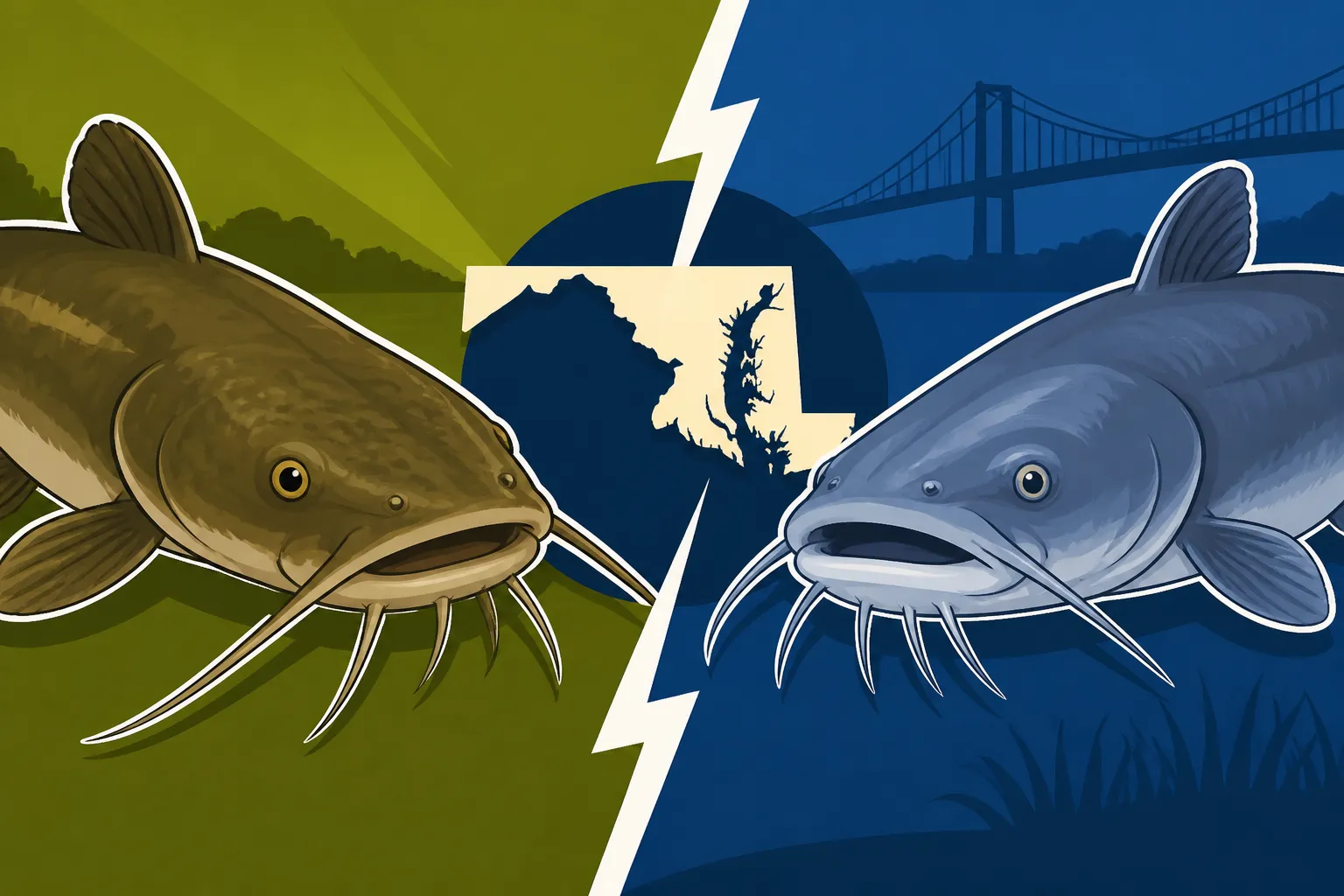
Flathead Catfish: True to its name, the flathead has a distinctively broad, flattened head, almost duck-bill-like when viewed from above. But here's the kicker: its lower jaw protrudes significantly beyond the upper jaw, giving it a permanent underbite. Think of it like a bulldog's jaw. Their eyes tend to be smaller, sometimes described as "beady" for a fish of their size, set fairly high on that flat head. They look like they're always staring upwards. This jaw structure is perfectly adapted for ambushing prey from below.
-
Blue Catfish: In contrast, the blue catfish has a more rounded and tapered head. While large blues can have a fairly wide head, it's rarely as flattened as a flathead's. A key feature to look for is that the upper jaw protrudes slightly beyond the lower jaw, or they might be fairly even. They do not have that pronounced underbite. On larger blues, especially mature ones, you might notice a prominent "dorsal hump" just behind their head, giving their back a rounded, almost muscular appearance. Their eyes tend to be larger and more centrally located on the side of their head compared to a flathead's.
Imagine you've just wrestled a big one onto the bank near Havre de Grace. You go to unhook it, and your eyes immediately scan its face. If that bottom lip is sticking out in a serious pout, you've got yourself a flathead. If it's more of an even grin, or the top lip slightly overlaps, you're likely holding a blue. It really is that distinct once you know what you're looking for! You can also find great visual guides and even identification posters for sale on platforms like Amazon to keep handy in your tackle box.
Fin Shapes and Counts: A Closer Look
Once you've checked the head, move your gaze back to the tail, or caudal fin. This is another major differentiator.
-
Flathead Catfish: The flathead's caudal fin is typically rounded or only very slightly notched, and importantly, it is not deeply forked. It might even look quite square or paddle-like. The edges are generally smooth and continuous.
-
Blue Catfish: The blue catfish, on the other hand, boasts a deeply forked caudal fin, much like a channel catfish, but usually more pronounced. This deeply V-shaped tail is a classic characteristic and one of the most reliable identification points.
Beyond the tail, you can also look at the anal fin. This is the fin located on the underside of the fish, behind the anus and before the tail. Counting the fin rays (the bony supports within the fin) is a more advanced technique but can be very conclusive:
- Flathead Catfish: Typically has a shorter anal fin with 14-17 rays.
- Blue Catfish: Possesses a very long anal fin with 30-35 rays, giving it an elongated, almost saw-like appearance along the belly. This extended fin is a dead giveaway once you spot it.
| Feature | Flathead Catfish | Blue Catfish |
|---|---|---|
| Head Shape | Broad, flattened, "duck-bill" like | More rounded, tapered, often with a dorsal hump |
| Jaw Position | Lower jaw protrudes (underbite) | Upper jaw protrudes slightly or jaws are even |
| Caudal (Tail) Fin | Rounded or slightly notched, not deeply forked | Deeply forked, V-shaped |
| Anal Fin Rays | 14-17 (shorter fin) | 30-35 (very long fin) |
| Coloration | Mottled brown/yellow/olive with dark splotches | Silvery-blue to slate gray, uniform color |
| Eyes | Smaller, "beady," set higher on the head | Larger, more centrally located |
Coloration and Body Pattern: Subtle Variations
Color can be tricky because it can vary depending on the water clarity, diet, and even the individual fish's mood. However, there are general patterns to look for:
- Flathead Catfish: These fish are typically mottled brown, yellowish-brown, or olive green, often with distinct dark spots, splotches, or blotches across their body, especially when younger. Their belly is usually a creamy yellow or off-white. This camouflaged pattern helps them blend into rocky or woody bottom structures.
- Blue Catfish: As their name implies, blue catfish usually exhibit a silvery-blue to slate gray coloration on their back and sides, fading to a pure white belly. They generally have a uniform color without distinct spots or mottling. While environmental factors can make them appear darker or lighter, they rarely have the blotchy pattern of a flathead.
So, if you pull up a fish with a yellowish, mottled appearance, looking like it's wearing camouflage, you're likely holding a flathead. If it's a sleek, silvery-blue torpedo, then it's probably a blue. Remember, color is a good supporting clue, but the head and tail structure are usually more definitive.
Habitat, Diet, and Behavior: More Clues on the Water
Beyond physical appearance, understanding where these catfish typically hang out and what they like to eat can give you further clues, even before you see them up close. Their preferences often dictate where you'll find them and what bait works best.
Where You're Likely to Find Them in Maryland
Knowing their preferred stomping grounds is an excellent way to narrow down the possibilities.
-
Flathead Catfish: These often prefer clearer, slower-moving river sections with lots of heavy cover. Think deep pools with rocky bottoms, log jams, submerged trees, and woody debris. They are more solitary predators, often hunkering down in these ambush points, waiting for unsuspecting prey. In Maryland, you might find them in tributaries of the Potomac River, or certain sections of the Upper Chesapeake Bay rivers where there's plenty of structure. If you're fishing a quiet, woody bend of a river with a good current seam, there's a higher chance it's a flathead lurking there.
-
Blue Catfish: Talk about adaptable! Blue catfish are incredibly prolific and can be found in a vast array of habitats, but they particularly thrive in the main channels of large, swift-moving rivers and the open waters of the Chesapeake Bay itself. They often prefer deeper water and can be found in large schools, especially when actively feeding. You'll encounter them frequently in the Potomac River, Patuxent River, Nanticoke River, Choptank River, and throughout the main stem of the Bay. They're less dependent on heavy cover and more prone to roaming widely. If you're targeting big cats in the middle of the river or deeper bay channels, chances are high you're chasing blues. Fishing the Potomac for Blue Catfish is a prime example of where these fish dominate.
What They Eat and How They Hunt
Their dinner menu and hunting style are quite different, which directly impacts bait selection and where you might hook them.
-
Flathead Catfish: These are almost exclusively live-bait predators. Their diet primarily consists of other fish – minnows, panfish, carp, even other catfish. They are ambush hunters, sitting patiently in cover and darting out to snatch their meal. They generally prefer fresh, wriggling bait. This means if you're consistently catching them on cut bait, you might want to double-check your identification, though exceptions exist.
-
Blue Catfish: Blue catfish are the ultimate opportunistic omnivores and scavengers. They'll eat just about anything! While they are certainly formidable predators of live fish, they also gorge on dead fish, clams, mussels, crabs, worms, and even some plant matter. They actively hunt and scavenge. This is why cut bait (like chunks of shad, menhaden, or even chicken liver) is incredibly effective for blues, as are many prepared baits. If you're using stink bait or large chunks of fresh cut bait, you're primarily targeting blue catfish. Understanding this difference is key to a successful catfishing trip; check out Best Bait for Blue Catfish in Maryland Rivers for more details.
Recommended Gear for Both Species
While both require robust tackle, understanding their behavior can refine your setup. For both species, you'll want a heavy-duty rod and reel combo capable of handling powerful runs and big fish. Think medium-heavy to heavy action rods, stout baitcasting reels spooled with 30-80 lb braided line, and strong circle hooks (sizes 7/0-10/0 are common). You'll also want plenty of heavy lead sinkers to hold your bait on the bottom in current.
For flatheads, because they favor structure and live bait, a sturdier leader to prevent abrasion on logs and rocks might be a good idea. For blues, especially in open, deep channels, having an assortment of cut baits is paramount. Regardless of which you're targeting, having a good knife for cutting bait, a sturdy pair of pliers for hook removal, and a large net or lip-gripper are essential. Many anglers keep a small, laminated identification guide in their tackle box, perhaps one they purchased from Amazon, for quick reference when the bite is hot.
Practical Tips for Anglers: Identifying Your Catch Instantly
When the action's fast and you're hauling in fish, you need quick, reliable methods to tell a flathead from a blue. It's not about being a marine biologist on the water; it's about practical checkpoints that anyone can use.
Quick Checkpoints on the Boat or Shore
Here’s a rapid-fire checklist you can run through when a big catfish lands in your boat or on the bank:
- The Jaw Test: This is often the most definitive. Gently hold the fish and observe its mouth.
- Underbite? Lower jaw visibly sticks out beyond the upper jaw? That's your Flathead.
- Even or Overbite? Upper jaw slightly beyond the lower, or perfectly even? That's your Blue.
- The Tail Test: Look immediately at the tail fin.
- Rounded or Barely Notched? No deep V-shape? Flathead.
- Deeply Forked, Clear V? Blue.
- The Color Test: A quick glance at the overall body.
- Mottled, blotchy, yellowish/brownish? Flathead.
- Sleek, silvery-blue to gray, uniform color? Blue.
- The Anal Fin Check (Bonus Round): If you're still unsure, or just want to confirm, look at that long fin on the underside.
- Short, compact fin? Flathead.
- Long, almost 'saw-like' fin extending far back? Blue.
These three (or four) checkpoints, when used together, will almost certainly give you the correct identification every time. It just takes a little practice! I’ve seen seasoned anglers out on the Chesapeake Bay near the Bay Bridge pilings still doing a quick jaw-check to be sure when they pull up a monster cat. Keeping a small, waterproof field guide in your pocket or a saved image on your phone can be a huge help, especially for beginners.
Why Misidentification Matters (and How to Avoid It)
As we touched on earlier, the repercussions of misidentifying these fish can range from minor annoyances to significant violations.
- Regulatory Implications: Imagine catching a limit of fish you thought were invasive blue catfish with no limits, only to find out they were flatheads, which usually have stricter bag and size limits. Maryland Fishing License Penalties for Violations can be quite steep, and ignorance of the law is rarely an excuse. Always double-check!
- Ethical Considerations: For the health of our ecosystem, Maryland actively encourages anglers to harvest invasive blue catfish. Releasing a blue catfish alive in certain waters can contribute to its spread and impact on native species. Conversely, wrongly harvesting a flathead when it should have been released due to limits is also a concern. Maryland Invasive Fish Rules: Blue Catfish and Snakehead highlight the importance of understanding these distinctions.
- Optimal Angling Practices: Knowing which species you're targeting allows you to refine your bait, tackle, and location choices, increasing your chances of success. If you’re set up for flatheads with live bait in a snag-filled river bend, you might miss out on a schooling blue catfish bite in the main channel with cut bait. And if you're focused on How to Catch Blue Catfish in the Potomac River, you'll want to be sure you're getting the right fish!
To avoid misidentification, it boils down to two things: education and observation. Take a moment with each catfish you catch. Don't just unhook and toss it back or into the cooler. Quickly run through the jaw and tail tests. Over time, these distinctions will become second nature, and you'll be able to tell them apart with just a glance. Consider joining a local fishing forum or club; experienced anglers are usually more than happy to share their knowledge and help new folks learn the ropes.
Disclaimer
This article is for general informational purposes only and does not constitute professional advice. Laws, prices and regulations vary by location and change over time. Consult a qualified professional for guidance on your specific situation.