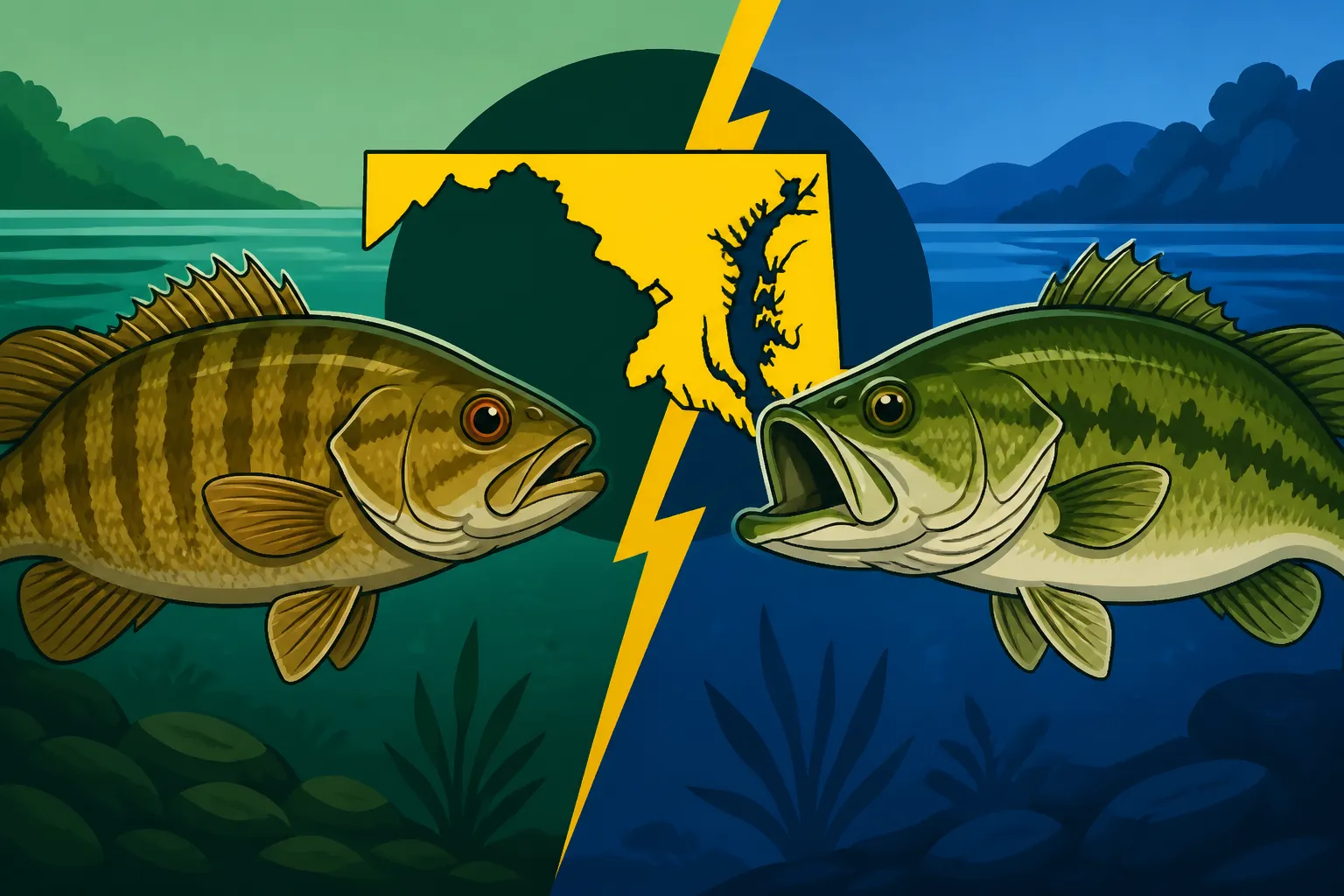
Smallmouth Bass vs Largemouth Bass in Maryland, How to Tell Them Apart
One of the most common head-scratchers for anglers in Maryland, especially those new to bass fishing or exploring unfamiliar waters, is telling the difference between a largemouth bass and a smallmouth bass. While both are fantastic sport fish that offer thrilling fights, they have distinct characteristics, preferred habitats, and even subtly different behaviors. This guide is here to walk you through all the key identifiers, helping you confidently distinguish between these two popular species the next time you reel one in.
The Initial Glance: Shape and Build
When you first land a bass, your eyes naturally take in its overall form. This first impression can often give you a strong hint about whether you’ve caught a largemouth or a smallmouth. They both have that classic bass profile, but with some crucial variations in their build.
Body Shape and Fin Differences
The most immediate difference in body shape often comes down to their general stoutness. Largemouth bass tend to have a more elongated, torpedo-like body, often appearing a bit wider or "chunkier" through the middle, especially larger specimens. Think of a football that's been stretched out a bit. Their dorsal fin, the one on their back, is clearly separated into two distinct parts: a spiny front section and a soft-rayed rear section. There's a noticeable, almost complete, dip or gap between these two parts, making it look like two separate fins rather than one continuous structure. This separation is a huge telltale sign once you know what to look for.
Smallmouth bass, on the other hand, typically possess a more compact, muscular, and "bronzed" looking body. They often appear deeper from back to belly, with a more streamlined, almost symmetrical oval shape, like a slightly compressed football. Their dorsal fin is also divided, but the separation between the spiny and soft-rayed sections is much less pronounced. It's more of a deep notch or indentation rather than a full split, making the fin look more continuous. You can easily run your finger across the top of their dorsal fin without feeling a distinct break, which is much harder to do with a largemouth. Their caudal fin, or tail fin, tends to be more forked than a largemouth's, giving them that powerful, fast-swimming capability in current.
Overall Size and Weight Expectations
While size can vary wildly based on age, diet, and water conditions, there are some general expectations for each species in Maryland. Largemouth bass generally grow larger and heavier than smallmouth bass in terms of maximum potential. It's not uncommon to hear tales of largemouth over 8 or 9 pounds coming out of Maryland's ponds and reservoirs, with the state record pushing into the double digits. These fish can get truly massive, developing thick bellies and broad shoulders as they age, especially in fertile waters with abundant forage.
Smallmouth bass, while incredibly strong for their size, typically top out at a smaller average weight. A 3 or 4-pound smallmouth is considered a very respectable catch, and a 5-pounder is often a "fish of a lifetime" for many anglers. The Maryland state record for smallmouth is still a hefty fish, but generally, they don't reach the sheer bulk that a trophy largemouth can. So, if you've got a truly enormous bass on the line, especially one pushing well past the 5-pound mark, there's a good chance it's a largemouth. Conversely, a hard-fighting, bronze-colored fish that weighs a few pounds is more likely a smallmouth, especially if you caught it in a river.
Mouth, Jaw, and Eye Tells
Moving beyond the general body shape, some of the most definitive identification clues are found on the fish's head, specifically around its mouth, jaw, and eyes. These features are consistently different between the two species and can quickly settle any debate.
The Critical Jawline Test
This is perhaps the most reliable and easy-to-spot difference, even for a beginner. Imagine holding the bass horizontally. Now, look closely at the corner of its mouth, where the upper and lower jaw meet, often called the maxilla. For a largemouth bass, this corner of the mouth extends significantly past the rear edge of its eye. It's almost like they have a perpetually wide grin, stretching back beyond what seems natural. You can easily draw an imaginary vertical line down from the back of the eye and see that the jawline goes well past it. This large, cavernous mouth allows them to swallow surprisingly large prey whole, which explains their name!
The smallmouth bass, true to its name, has a noticeably smaller mouth. When you perform the same jawline test, the corner of its mouth will generally not extend past the rear edge of its eye. In many cases, it barely reaches the middle of the eye, or just slightly beyond the front edge, but very rarely past the back. This more modest mouth is better suited for their typical diet of crayfish and smaller baitfish, which are often found in the rocky, clearer waters they prefer. Once you've seen this difference a few times, it becomes second nature to spot it. It’s a trick I learned decades ago and it still holds true!
Eye Color and Placement Cues
While not as definitive as the jawline test, the eyes can offer subtle hints. Largemouth bass often have eyes that appear more centrally placed on their head, perhaps blending a bit more with their overall green or olive coloration. The iris, or colored part of their eye, is usually a darker shade, often matching their overall body tone or being a dark brown or black. Their eyes might seem a bit smaller in proportion to their very large head and mouth.
Smallmouth bass, on the other hand, frequently have eyes that appear larger in proportion to their head, giving them a slightly more "bug-eyed" look. The most striking feature, however, is often the color of their iris, which tends to be a vibrant red or orange, sometimes with a golden hue. This reddish-orange eye can be quite distinct, especially in clear water or when the fish is freshly caught. The placement might also seem slightly more forward or higher on their head, contributing to that compact, muscular appearance. Observing these eye characteristics in conjunction with the jawline and body shape can help solidify your identification.
Coloration and Markings: Nature's Camouflage
Bass are masters of camouflage, and their coloring can change dramatically depending on the water clarity, bottom composition, and even their stress levels. However, there are some characteristic patterns and hues that generally distinguish a largemouth from a smallmouth, especially when they are calm and in their natural environment.
Lateral Line Patterns
The most prominent marking on both species is the lateral line, a sensory organ running horizontally along their sides. For a largemouth bass, this lateral line is typically accentuated by a distinct, dark, and often broken horizontal stripe or band. This stripe can vary from almost black to a faded charcoal, but it's usually quite clear, running from the gill plate all the way to the tail. Sometimes, especially in younger fish or those from very clear water, this stripe might appear as a series of blotches that form a jagged line. The rest of their body might have fainter, less organized blotches or spots, but that horizontal stripe is the main event. In very dark or muddy water, the stripe might be faint, but it's still usually present as the primary pattern.
Smallmouth bass, in contrast, rarely feature a distinct horizontal stripe. Instead, their sides are usually adorned with a series of dark, vertical bars or tiger-like stripes. These bars can be very prominent, almost like camouflage, especially when the fish is stressed or in rocky cover. In some instances, particularly on smaller fish or those from very clear, sandy bottoms, these vertical bars might be faded or appear as a series of dark blotches. However, the key is the vertical orientation rather than a strong horizontal band. You might even notice faint horizontal lines too, but they don't form that continuous, bold lateral stripe that defines the largemouth. This pattern helps them blend in perfectly with the broken shadows and varied terrain of riverbeds and rocky lake bottoms.
Overall Body Color and Spots
Beyond the lateral line, the general body color also provides strong clues. Largemouth bass are, as many anglers describe, generally "green." Their backs are typically a deep olive or emerald green, fading to lighter green or yellowish-green sides, and a white or cream belly. In very clear water with sandy bottoms, they can appear much lighter, almost golden-green. In darker, stained water, they might take on a deeper, almost black-green hue. Their scales are typically smooth and uniform in appearance. Sometimes, you'll see scattered dark spots or speckles, but these are secondary to the overall green palette and the distinct lateral stripe.
Smallmouth bass, on the other hand, are often referred to as "bronzebacks" for a reason. Their dominant coloration is typically a range of brown, golden-brown, or bronze, fading to a lighter, often yellowish or white belly. This bronze color can be quite striking, especially when they come out of cold, clear water. Their sides are usually covered in small, dark spots or specks that can sometimes cluster to form those vertical bars. These spots are usually more numerous and widespread than on a largemouth. The contrast in coloration is often one of the first things experienced anglers notice. Imagine a fish that looks like it's made of burnished copper versus one that looks like a leaf from a healthy oak tree – that's the general visual difference. This distinct color allows them to blend in with the rocky bottoms and gravel beds of rivers and clear lakes where they love to hunt.
Habitat Hints: Where Each Bass Calls Home in Maryland
Knowing where you're fishing in Maryland can often give you a strong heads-up about which type of bass you're more likely to encounter. While there can be some overlap, largemouth and smallmouth bass generally prefer very different kinds of environments, driven by their biological needs and prey availability.
Largemouth's Preferred Environments
Largemouth bass are truly the kings of "structure and cover" in still or slow-moving water. They absolutely thrive in warm, often murky or stained waters with plenty of vegetation, submerged timber, docks, lily pads, and brush piles. Think of your classic farm ponds, impoundments, and the calmer coves and tributaries of larger rivers and reservoirs. In Maryland, places like Loch Raven Reservoir, Liberty Reservoir, Piney Run Reservoir, and countless ponds on the Eastern Shore are prime largemouth territory. They love to ambush prey from thick cover, so anything that provides shade and a hiding spot is fair game.
These fish are less tolerant of strong currents and prefer softer bottoms, often composed of mud, silt, or sand, where they can root around for crayfish, minnows, and larger baitfish. You'll find them holding tight to weed lines, under overhanging branches, or next to sunken logs, waiting for an unsuspecting bluegill or shad to swim by. They're often found in water that might not be crystal clear, as their vision and lateral line are well-adapted to detect prey in lower visibility conditions. If you're fishing a quiet backwater slough on the Choptank River or casting into a lily pad field, your chances of hooking into a nice largemouth are significantly higher.
Smallmouth's Favorite Haunts
Smallmouth bass, on the other hand, are creatures of current and clear water. They prefer cooler, rocky rivers and large, deep lakes with gravel or boulder bottoms. If you're wading the swift currents of the Potomac River above the tidal influence, or casting along the rocky shores of Deep Creek Lake, you're squarely in smallmouth country. They love to hold behind boulders, in riffles, and along ledges where the current breaks, allowing them to ambush prey that gets swept downstream. Unlike largemouths, they're not typically found buried deep in dense vegetation.
Their diet heavily relies on crayfish, which are abundant in rocky environments, as well as various minnows and insects. Smallmouth are built for speed and power in current, with their more streamlined bodies and strong, forked tails. They are much more tolerant of colder water temperatures and require higher oxygen levels, which are typically found in moving water or deeper, cooler lake sections. If you're targeting smallmouth, look for current breaks, ledges, submerged rock piles, and points in clear-water environments. Even in large reservoirs that hold largemouth, smallmouth will seek out the deeper, rockier sections, especially near inflows or outflows where current is present. The Nontidal Upper Potomac for Smallmouth Bass is a classic example of their preferred domain.
Fishing Strategies and Behavioral Differences
Understanding the differences between largemouth and smallmouth bass goes beyond just identification; it also informs how you approach catching them. Their distinct temperaments and preferences for forage and structure mean you'll often employ different tactics, even if both species might technically exist in the same general watershed.
How They Fight on the Line
This is where the excitement really kicks in, and the fight itself can often tell you which bass species you've hooked! Largemouth bass are known for their powerful initial runs, head shakes, and dramatic aerial acrobatics, often "jumping" to try and throw the hook. They tend to make strong, bullish surges towards heavy cover, trying to bury themselves in weeds or around submerged timber. Their fighting style is often described as a series of explosive, heavy thrashes, with solid pulls and sudden changes in direction. They use their broad, flat bodies to gain leverage against the line, and if they get into thick cover, it's often game over for the angler. The sound of a big largemouth breaking the surface and shaking its head is truly unforgettable.
Smallmouth bass, by contrast, are renowned for their relentless, dogged, and acrobatic fights, especially in current. While they might not get as large as a largemouth, they are incredibly strong for their size and are often considered pound-for-pound the hardest-fighting freshwater fish. They make blistering runs, often deep, and will execute multiple jumps and spectacular leaps, sometimes seemingly out of nowhere. Instead of trying to bury themselves in cover, they often use the current to their advantage, pulling against the line with astonishing power, and rarely give up until they're in the net. Their fight is characterized by rapid, darting movements, quick changes in direction, and a feeling of pure, unadulterated power from a fish that just won't quit. Fishing Techniques for Smallmouth Bass in the Potomac often involve gear capable of handling these intense battles.
Bait and Lure Preferences
Their differing habitats and feeding habits mean that certain baits and lures are often more effective for one species than the other, though there's certainly overlap. For largemouth bass, presentations that mimic shad, bluegill, or frogs are often key. Soft plastics like Texas-rigged worms, Senkos, creature baits, and jig-and-trailer combos are hugely popular for probing cover. Topwater lures like poppers, frogs, and buzzbaits are incredibly exciting to use when largemouth are active in shallow, weedy areas. Spinnerbaits, swim jigs, and crankbaits that dive to different depths are also very effective, especially when fished around submerged timber or grass lines. Many anglers swear by the effectiveness of a well-presented plastic worm or a loud topwater plug for coaxing a largemouth out of its lair. If you're looking for a wide variety, Amazon is always a great spot to explore new baits and colors.
Smallmouth bass have a strong affinity for crayfish, so lures that imitate these crustaceans are often deadly. Jigs with soft plastic trailers, tube baits, and small crankbaits that resemble crawfish are top producers. Smallmouth also readily hit a variety of other baits, including small spinnerbaits, inline spinners, jerkbaits, and finesse techniques like drop-shotting and Ned rigs. They are often less shy about feeding in open water or along current seams, making them susceptible to moving baits. Topwater action for smallmouth can be explosive, especially with poppers or walking baits fished around rocky points. Since they often feed by sight in clear water, subtle, natural presentations can be very effective. Finding the Best Crankbaits for Susquehanna Smallmouth Bass might just be the key to a successful trip.
Why Identification Matters (Beyond Bragging Rights)
Knowing your bass isn't just about sounding knowledgeable at the boat ramp or accurately describing your catch to friends. It has real-world implications, particularly when it comes to following regulations and contributing to conservation efforts. Misidentification can lead to unintentional violations or missed opportunities to help manage our fisheries.
Regulation Compliance
Maryland, like many states, often has different size and creel (daily possession) limits for different species of fish, and bass are no exception. The regulations for Maryland Largemouth Bass Size Limit by Water can sometimes differ from those for smallmouth bass, or there might be specific rules for certain bodies of water. For instance, some reservoirs might have a slot limit for largemouth bass, meaning you can only keep fish within a certain size range, while others might have a simple minimum size limit. The idea is to protect certain segments of the population, often the larger, more prolific breeders.
If you mistakenly identify a smallmouth as a largemouth, or vice versa, you could inadvertently keep an illegal fish or release one that was legal to keep. This isn't just about avoiding a fine; it's about being a responsible angler who respects the rules designed to ensure healthy fish populations for everyone. Always consult the current Maryland DNR fishing guide, which you can often find online or pick up at your local tackle shop, before hitting the water. Taking the time to correctly identify your catch is a crucial part of ethical angling, and it ensures you're doing your part to comply with the rules.
Conservation Efforts
Beyond immediate regulations, accurate identification plays a vital role in broader conservation efforts. Fisheries biologists rely on accurate catch data, often reported by anglers, to monitor populations, understand spawning success, and assess the health of different ecosystems. If anglers consistently misidentify species, the data becomes skewed, making it harder for wildlife agencies to make informed management decisions. Knowing whether you caught a Largemouth Bass State Record in Maryland or a different species helps paint a clearer picture of fish distribution and abundance.
For example, smallmouth bass populations in rivers like the Potomac require different management strategies than largemouth bass thriving in a warm-water reservoir. Habitat preservation, stocking programs, and harvest limits are all tailored to specific species and their environmental needs. When anglers accurately identify and report their catches (especially trophy fish or unusual observations), they become citizen scientists, providing valuable information that helps protect and enhance Maryland's diverse fisheries. So, the more you learn to distinguish these two magnificent bass, the more you contribute to their long-term survival and the health of the waters we all love to fish.
Key Differences at a Glance: Largemouth vs Smallmouth Bass
To help you quickly summarize the major points, here’s a handy comparison table. This is the kind of cheat sheet I wish I had when I was first starting out, trying to remember all those little details on the water!
| Feature | Largemouth Bass | Smallmouth Bass |
|---|---|---|
| Body Shape | More elongated, "football-like," often chunkier | More compact, muscular, "bronzed," deeper body |
| Dorsal Fin | Deep, almost complete separation into two fins | Shallow notch, appears more continuous |
| Jawline Test | Corner of mouth extends past the eye | Corner of mouth does not extend past the eye |
| Eye Color | Usually darker, brown/black, blends in | Often reddish or orange, stands out |
| Lateral Markings | Distinct, dark, horizontal stripe (often broken) | Vertical bars or tiger stripes, faint spots |
| Overall Color | Green, olive green, yellow-green | Bronze, brown, golden-brown |
| Preferred Habitat | Warm, still/slow water, heavy vegetation, soft bottom | Cooler, clear, flowing water, rocky/gravel bottom |
| Typical Fight | Explosive, head shakes, jumps, runs to cover | Relentless, acrobatic leaps, strong runs in current |
| Max Size | Generally larger, heavier (e.g., How Big Do Largemouth Bass Get in Maryland Ponds?) | Generally smaller, but pound-for-pound stronger (e.g., How Big Do Smallmouth Bass Get in the Susquehanna?) |
Next time you're out on a Maryland lake or river, whether you're chasing that trophy Best Waters for Trophy Largemouth Bass in Maryland or the hard-fighting Smallmouth Bass in Maryland's Rivers, you'll have the knowledge to accurately identify your catch. Knowing the subtle clues can make you a more informed and successful angler, helping you fine-tune your techniques and appreciate the unique qualities of each amazing species. Happy fishing!
Disclaimer
This article is for general informational purposes only and does not constitute professional advice. Laws, prices and regulations vary by location and change over time. Consult a qualified professional for guidance on your specific situation.