Black Crappie vs White Crappie in Maryland Waters
You've just landed a mess of delicious panfish, perhaps from a quiet cove in Loch Raven or a stump-filled eddy on the Potomac, and you're admiring your catch. But then the question hits you: "Are these black crappie, or white crappie?" It’s a common moment of confusion for many Maryland anglers, and trust me, you're not alone in wondering how to tell the difference. This guide is here to clear up that mystery, helping you confidently identify your crappie and even fine-tune your fishing approach for each specific species in our beautiful Maryland waters.
The Tale of Two Crappies: Key Identification Differences
Let's face it, when you're out on the water, especially in the low light of dawn or dusk, or when the fish are flopping around in the bottom of your cooler, distinguishing between black and white crappie can feel like a game of "spot the difference" that you're constantly losing. But there are some clear giveaways once you know what to look for. It's not just about color, though that's often the first thing people notice – and can sometimes be misleading!
Visual Cues: Spots, Stripes, and Dorsal Spines
The easiest and most reliable way to tell a black crappie from a white crappie is by looking at their markings and counting the spines on their dorsal fin. Think of it like a secret code only fellow anglers know!
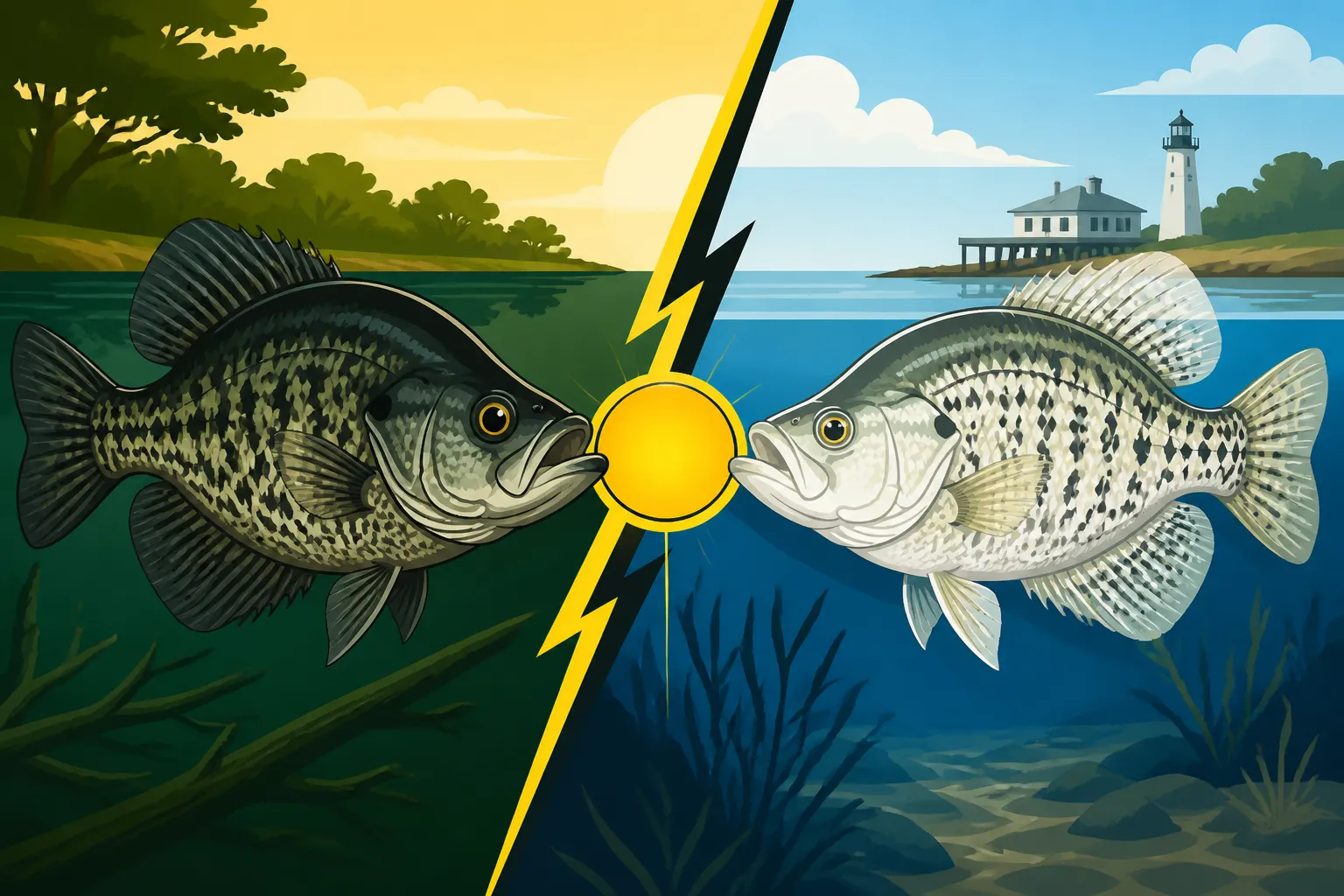
Black crappie, Pomoxis nigromaculatus, typically have a darker, more mottled appearance. Their sides are usually covered in irregular, distinct black spots that look almost like sprinkles scattered all over their body. It's not a uniform pattern, which can make them quite striking. But the real clincher is their dorsal fin (the one on their back). If you gently count the spines, you'll almost always find that black crappie have seven or eight dorsal spines. This is a consistent anatomical feature that rarely varies, making it a super reliable identifier.
White crappie, Pomoxis annularis, on the other hand, often present a lighter, more silvery coloration, though this can vary greatly depending on water clarity and diet. What sets them apart visually are the vertical bars or stripes running down their sides. These bars can be faint or quite prominent, sometimes looking like shadowy bands. Unlike the random spots of their black crappie cousins, these vertical stripes are their signature. And just like with the black crappie, the dorsal fin is your best friend for a definitive ID. White crappie will typically have five or six dorsal spines. So, next time you've got one in hand, give those spines a careful count – it’s the quickest way to solve the puzzle.
Size and Shape: Beyond the Spots
While the spots, stripes, and dorsal spines are the definitive ways to identify your crappie, there are also some general body shape and size tendencies that can offer clues. It's not as foolproof, but combined with the fin count, it paints a clearer picture.
Black crappie tend to have a deeper, more compressed body shape, appearing almost rounder or disc-like when viewed from the side. They often have a somewhat larger mouth compared to their overall head size. While individual fish vary wildly, the state record for black crappie in Maryland is a testament to how robust these fish can grow, though most you catch will be smaller, pan-sized delights.
White crappie usually exhibit a more elongated or slender body profile compared to their black crappie counterparts. They often appear to be "stretched out" a bit more. Their heads also tend to be a little longer. In Maryland waters, both species can grow to impressive sizes, but there's a popular notion that white crappie might reach slightly larger average sizes in certain environments, though this isn't a hard and fast rule. When you're holding a really big slab, it's a thrill regardless of its exact species, but these subtle shape differences can sometimes hint at which one you've landed before you even count those precious dorsal spines.
Where They Live and How They Behave in Maryland Waters
Understanding where black and white crappie prefer to hang out in Maryland can not only help with identification but also dramatically improve your fishing success. They both love structure, but their specific preferences often lead them to different types of environments. Knowing this can help you choose the right fishing spots.
Preferred Habitats: Clear Water vs. Turbid Waters
Believe it or not, these two closely related species have distinct preferences when it comes to the water they call home. It’s not just a matter of taste; it’s about survival, feeding, and spawning.
Black crappie generally prefer clearer, cleaner water with abundant aquatic vegetation, submerged timber, brush piles, lily pads, and other forms of complex cover. Think of environments like Loch Raven Reservoir, Liberty Reservoir, or quiet, healthy coves in smaller tidal creeks that aren't subject to heavy boat traffic or sediment. They thrive where they can camouflage among the weeds and ambush prey from dense cover. You'll often find them tucked right into the heart of a brush pile or along the edge of a deep weed line. If you're fishing a spot in Maryland that fits this description, especially one known for its healthy plant growth, there's a good chance you're targeting black crappie.
White crappie, while still appreciating structure, are often more tolerant of turbid or slightly murky waters. You'll frequently find them in larger, slower-moving rivers like the Potomac or some of the major tidal tributaries of the Chesapeake Bay, particularly around bridge pilings, submerged stumps, laydowns, and channel edges. They might not hug the densest vegetation quite as tightly as black crappie, often preferring slightly more open water but still relating to some form of cover. Places like the upper reaches of the Chesapeake Bay, parts of Fishing the Choptank River, or even the Susquehanna Flats in Maryland after a rain, might lean more towards white crappie territory. Their adaptability to different water clarities means they can often be found in a wider range of riverine and reservoir environments across the state.
Spawning Habits and Timing
Both species are spring spawners, which is fantastic news for anglers because that's when they're most concentrated and often easiest to catch. However, there can be subtle differences in their preferred conditions and locations, even if their overall timing overlaps considerably.
Generally, crappie begin moving into shallower waters to spawn when water temperatures reach the high 50s to low 60s Fahrenheit. Black crappie tend to be slightly earlier spawners and might prefer slightly cooler water temperatures than white crappie, often initiating their spawning rituals when the water hits around 58-64 degrees Fahrenheit. They'll typically build nests in areas with hard bottoms, often surrounded by heavy cover like submerged brush or thick vegetation, anywhere from one to five feet deep. These are prime targets for anglers in early spring.
White crappie usually follow suit a bit later, preferring water temperatures closer to 60-68 degrees Fahrenheit. They also seek out shallow, protected areas for spawning, but may be found in slightly more open areas or near stumps and logs rather than dense vegetation. Both species are fiercely protective of their nests, making them aggressive and relatively easy to catch during this period. Understanding this slight difference in preference can give you an edge, allowing you to target specific areas as the spring progresses and water temperatures fluctuate. Knowing when the White Perch Spawning Runs in Maryland Rivers occur can also give you a good indication of when other panfish might be on the move, as many species key into similar temperature ranges.
Fishing Strategies: Targeting Each Crappie in Maryland
So, you've learned to identify them, and you know where they generally like to live. Now, how do you actually catch them? While many general crappie fishing techniques work for both species, fine-tuning your approach based on whether you're after black or white crappie can make a significant difference in your catch rates.
Lures and Baits: Tailoring Your Approach
Crappie, in general, are not known for being picky eaters, but they do have preferences, and those preferences can shift slightly between species due to their typical habitats and feeding behaviors.
For black crappie, which often inhabit clearer water and denser cover, a more finesse approach is often key. Tiny jigs, especially those in the 1/32 to 1/16 ounce range, tipped with a small plastic grub, tube, or a live minnow, are deadly. Natural colors like clear, smoke, or light greens often work well in clear water. Consider using jigs that mimic small insects or baitfish. Many anglers find that a high-quality assortment of micro jigs, easily found on Amazon, gives them the versatility they need. When they're really buried in structure, a simple bobber and minnow setup fished precisely into pockets of cover can be unbeatable.
White crappie, sometimes found in slightly more turbid water or more open areas, might respond to a slightly broader range of baits. While small jigs and minnows are still top performers, don't shy away from slightly larger jigs (up to 1/8 ounce) or even small crankbaits that dive to appropriate depths. Bright colors like chartreuse, orange, or white can be very effective in stained water, offering better visibility. Trolling with these larger baits or even small spinner rigs can cover more water and entice a bite from white crappie that might be suspended more openly. Always check the current Maryland Fishing Size and Catch Limits by Species for crappie to ensure you're compliant.
Techniques and Locations in Maryland
Beyond the bait, the way you present it and where you present it are crucial. Different crappie species, due to their habitat preferences, often require different angling tactics.
For black crappie in Maryland's clearer reservoirs and vegetated creeks, a stealthy and precise approach is often best. Vertical jigging directly into thick brush piles, submerged Christmas trees, or under docks is highly effective. You might use a boat with a good fishfinder to locate these structures, then position yourself directly over them. Another popular method is "spider rigging" – using multiple rods with various depths and baits, fanned out around the boat, to probe different levels of the water column. The key is to get your bait right in their face, often with minimal movement. This method is incredibly productive in places like Fishing Loch Raven Reservoir or Fishing Liberty Reservoir.
White crappie, especially in larger rivers like the Fishing the Potomac River in Maryland or open areas of the Chesapeake's tributaries, might be caught using trolling or casting techniques. Trolling with small crankbaits or jigs and minnows allows you to cover large areas and locate schools that might be suspended. When targeting specific structures like bridge pilings or large laydowns, casting jigs or minnows and allowing them to sink slowly through the strike zone can be deadly. Often, white crappie schools will suspend at a particular depth over open water, so using your electronics to find them and then presenting your bait at that exact depth is key. For more in-depth strategies specific to certain bodies of water, check out guides like Techniques for Crappie in Maryland Reservoirs.
The Crappie Fishing Experience: What to Expect
No matter if you're pulling in black or white crappie, the experience of catching these "papermouths" is uniquely Maryland, offering a blend of challenge and consistent reward that keeps anglers coming back year after year.
Maryland's Crappie Fishery Overview
Maryland is truly a fantastic place to fish for crappie, with a robust fishery that provides ample opportunities for both species. They are widely distributed throughout our freshwater reservoirs, ponds, and many tidal rivers. Crappie are celebrated not only for their sporting fight on light tackle but also for their reputation as one of the finest-eating freshwater fish available. Their delicate, flaky white meat is a favorite on many dinner tables, making a crappie fishing trip often turn into a delicious meal.
The populations of both black and white crappie are generally healthy in Maryland, thanks to varied habitats and good management practices. While they may not get as much press as striped bass or largemouth bass, crappie fishing offers a more relaxed, often family-friendly experience that can be incredibly rewarding. It’s a great way to introduce new anglers to the sport, as bites are often frequent, and the action can be steady, especially during the spring spawn.
Gear Considerations for Maryland Crappie
To truly enjoy crappie fishing, having the right gear is paramount. These fish have delicate mouths (hence the "papermouth" nickname), so a gentle touch and appropriate tackle are essential.
For both species, ultralight spinning gear is your best friend. A rod in the 5 to 6-foot range with a fast action and a sensitive tip will allow you to detect the subtle bites of crappie. Pair this with a small, lightweight spinning reel spooled with 2 to 6-pound test monofilament or fluorocarbon line. The light line is crucial for casting small jigs and ensuring a natural presentation, especially in clear water or when fish are finicky. Many anglers prefer monofilament for its stretch, which helps absorb the shock of a strike and prevents hooks from tearing through their soft mouths.
When it comes to terminal tackle, a variety of small jig heads (1/32 to 1/8 ounce) are indispensable, along with an assortment of small plastic grub bodies, tubes, and even tiny spoons. Having a good selection of bobbers, from small clip-on models to slip bobbers, is also helpful for presenting baits at specific depths. You can find excellent value in combo packs of crappie jigs and soft plastics, and reliable brands of ultralight reels are readily available through online retailers like Amazon. Don't forget a small pair of pliers or forceps for hook removal, as their mouths are small, and sometimes hooks can be deeply set.
Comparing the Crappies in Maryland
Here's a quick reference table to help you remember the key differences:
| Feature | Black Crappie (Pomoxis nigromaculatus) | White Crappie (Pomoxis annularis) |
|---|---|---|
| Markings | Irregular, distinct black spots | 5-9 distinct vertical bars/stripes |
| Dorsal Spines | 7-8 dorsal spines | 5-6 dorsal spines |
| Body Shape | Deeper, more rounded/compressed body | More elongated, slender body |
| Preferred Habitat | Clearer water, dense vegetation, brush piles, docks | More tolerant of turbid water, open water, stumps, laydowns, bridge pilings |
| Spawning Temp. | ~58-64°F, often slightly earlier | ~60-68°F, often slightly later |
| Common Locations in MD | Loch Raven, Liberty, dense creek coves | Potomac River, larger tidal rivers, Susquehanna Flats |
| Typical Lures | Small jigs (1/32-1/16 oz), minnows | Jigs (up to 1/8 oz), minnows, small crankbaits |
Next time you're out fishing in Maryland, you'll be able to tell the difference between these two fantastic panfish, giving you a deeper appreciation for each catch and perhaps even a better strategy for filling your cooler. Whether you're after the spotted denizens of a clear reservoir or the striped river dwellers, crappie fishing in Maryland promises fun and a delicious reward.
Disclaimer
This article is for general informational purposes only and does not constitute professional advice. Laws, prices and regulations vary by location and change over time. Consult a qualified professional for guidance on your specific situation.