Striped Bass vs Hybrid Striped Bass, What’s the Difference
Navigating the world of fishing in Maryland can sometimes feel like trying to untangle a particularly stubborn fishing knot, especially when it comes to identifying similar-looking species. One common point of confusion for many anglers, myself included at times, is the difference between a purebred Striped Bass, affectionately known as Rockfish around here, and a Hybrid Striped Bass. It's not just a matter of semantics; knowing which fish you've hooked can impact everything from your technique to the legalities of keeping your catch. This guide is here to clear up that confusion, giving you the knowledge you need to confidently identify these magnificent fish.
Understanding the True Striped Bass (Rockfish) in Maryland
Let's start with the fish that holds a special place in every Marylander's heart: the Striped Bass, or Rockfish. This isn't just a fish; it's the fish, our state fish, and an icon of the Chesapeake Bay. When you talk about catching a "striper" in the Bay, this is the one we mean.
Natural Habitat and Behavior of Wild Stripers
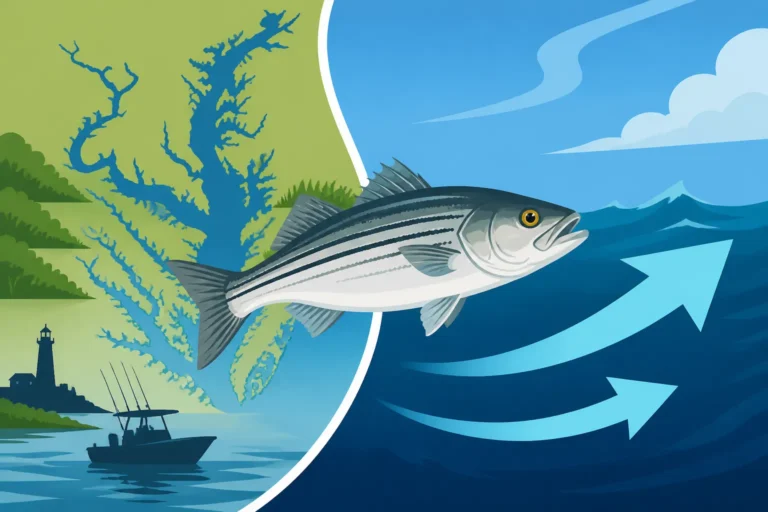
Wild Striped Bass are truly creatures of the estuary, migrating seasonally between their spawning grounds in the freshwater tributaries of the Chesapeake Bay and the open ocean. They're anadromous, meaning they live primarily in saltwater or brackish water but return to freshwater to spawn. In Maryland, the Chesapeake Bay is a critical nursery ground, offering a perfect mix of fresh and saline waters for their young to grow before heading out to the Atlantic. You'll find them cruising along channel edges, around underwater structures, and ambushing baitfish like menhaden, herring, and spot. Their movements are often dictated by water temperature and the availability of their food sources. During the spring, they push into rivers to spawn, and throughout the summer and fall, they're active predators across the Bay, often gathering in large schools. Their life cycle is deeply intertwined with the health of the Bay itself.
When you're out on the water, you'll notice their powerful runs and strong fighting spirit, especially during the spring trophy season or the fall migration. They are apex predators in their environment, known for their aggressive feeding habits. Understanding their seasonal movements and preferred habitats is key to success, whether you're trolling the main stem of the Bay or jigging near structure in a tidal river. Maryland Striped Bass Fishing Techniques are as varied as the Bay itself, but all are aimed at this powerful fish.
Physical Characteristics of a Purebred Striped Bass
Identifying a purebred Striped Bass usually comes down to a few distinct physical traits. Their body is generally long and slender, built for speed and power in open water. The most telling feature, of course, is their stripes. A purebred Striped Bass typically has seven or eight prominent, unbroken horizontal stripes running along its silvery body, from gill plate to tail. These stripes are usually solid and don't get splotchy or broken towards the tail.
Their head is also a good indicator; it's relatively large, and the lower jaw protrudes slightly beyond the upper jaw, giving them a determined look. Their scales are relatively large and uniform. The dorsal fins are separate: a spiny front dorsal and a soft-rayed rear dorsal. The anal fin has a few spines before the soft rays. When you hold one of these beauties, their streamlined form and firm musculature speak volumes about their life spent battling currents and chasing baitfish. It's a truly magnificent fish to behold.
Maryland's Connection to the Striped Bass
For Marylanders, the Striped Bass isn't just a fish to catch; it's a way of life. It’s our state fish for a reason. Generations have grown up fishing for rockfish, creating countless memories on the water. The fishery is not only culturally significant but also an enormous economic driver for coastal communities, charter boats, tackle shops, and restaurants. However, this deep connection also comes with a significant responsibility to protect the species. Overfishing and habitat degradation have put immense pressure on Striped Bass populations over the years, leading to strict regulations and ongoing conservation efforts. Striped Bass: Maryland's State Fish explains just how important this species is to our state.
The Maryland Department of Natural Resources (DNR) works tirelessly to manage the population, implementing specific seasons, size limits, and catch limits to ensure the species thrives for future generations. This constant management means that regulations can change, so staying informed with resources like Maryland's DNR Fishing and Boating Guide, Explained is crucial for any angler. When you catch a legal-sized Striped Bass, you're participating in a tradition that defines much of Maryland's identity.
Delving into Hybrid Striped Bass: The Man-Made Marvel
Now, let's talk about their cousin, the Hybrid Striped Bass. Often called "wipers" or "sunshine bass" (depending on which parent is male or female, but they're generally grouped as hybrids), these fish are a fantastic angling opportunity in their own right, especially in environments where purebred stripers don't naturally thrive.
What Exactly is a Hybrid Striper?
A Hybrid Striped Bass is precisely what it sounds like: a crossbreed. It's typically created by breeding a female Striped Bass (Morone saxatilis) with a male White Bass (Morone chrysops). This genetic cross results in a fish that often exhibits "hybrid vigor," meaning they grow faster and are more tolerant of a wider range of conditions, particularly warmer freshwater environments, than their purebred Striped Bass parent. They're bred specifically for aquaculture and for stocking landlocked freshwater systems, providing excellent recreational fishing opportunities where traditional stripers wouldn't survive or reproduce naturally.
These hybrids combine the fighting spirit of the Striped Bass with the hardiness and prolific nature of the White Bass. They are infertile, meaning they cannot reproduce, so their populations in lakes and reservoirs must be maintained through regular stocking programs. This characteristic is part of their appeal for fishery managers, as it allows for controlled populations and prevents them from overpopulating a water body. You can find excellent resources, from fishing guides to specialized lures for hybrid stripers, on platforms like Amazon.
Where You'll Find Hybrid Stripers in Maryland
Unlike their purebred cousins who prefer the brackish and saltwater realms of the Chesapeake Bay, Hybrid Striped Bass are predominantly found in Maryland's larger freshwater reservoirs and lakes. These are typically impoundments where natural Striped Bass populations wouldn't be sustainable or where the goal is to provide a hard-fighting game fish to diversify the angling experience. Think of places like Liberty Reservoir, Loch Raven Reservoir, and Piney Run Reservoir. These waters are carefully managed by the DNR, with hybrids stocked to create a vibrant fishery.
You won't typically find healthy, self-sustaining populations of Hybrid Stripers in the tidal rivers or the main stem of the Chesapeake Bay, though an occasional straggler might wander in from an upstream reservoir. Their true domain is the deeper, open waters of these large freshwater bodies, where they school up and chase baitfish like shad, alewives, and sunfish. Fishing these waters for hybrids can be a blast, offering a different kind of challenge than Bay fishing. Fishing Loch Raven Reservoir and Fishing Liberty Reservoir are prime examples of places where you can target these feisty hybrids.
Key Identifiers: How to Spot a Hybrid
When you pull a hybrid striper out of the water, you'll immediately notice some differences from a purebred. Their body shape tends to be a bit deeper or more "stubby" than the purebred striper, giving them a stockier appearance. But the most reliable identifier is, again, their stripes. While they have similar horizontal stripes, those on a hybrid are typically broken, irregular, or splotchy, especially below the lateral line and towards the tail. Instead of solid, continuous lines, you'll see segments, dashes, and sometimes even wavy patterns.
Another subtle but helpful clue can be the number of distinct stripe lines that reach the tail. On a purebred, most stripes will run the full length without interruption, while on a hybrid, fewer stripes will be complete, and many will be noticeably fractured or disconnected. Their head might also appear slightly smaller in proportion to their body compared to a purebred. These small visual cues can make all the difference in identification.
The Hybrid's Role in Maryland Fisheries
The Hybrid Striped Bass plays a crucial role in Maryland's freshwater fisheries management. By stocking these fish in reservoirs, the DNR provides fantastic angling opportunities for those who prefer freshwater fishing or who live inland, away from the Chesapeake Bay. They're a powerful, aggressive game fish that can reach impressive sizes, making them a popular target for many anglers. This also helps to diversify fishing pressure, taking some of the strain off wild Striped Bass populations in the Bay.
Because they are infertile, their populations are entirely controlled by stocking, which allows fishery managers to maintain a healthy balance within the ecosystem. This ensures a consistent supply of hard-fighting fish for recreational anglers without the risk of overpopulation or competition with native species for spawning grounds. When you head out to a local reservoir, catching a hybrid is a testament to thoughtful fisheries management that provides diverse experiences for all types of anglers in Maryland.
Telling Them Apart on the Water: Practical Tips for Anglers
Alright, so you've hooked a fish, and it's putting up a great fight. Now comes the moment of truth: is it a Striped Bass or a Hybrid Striped Bass? Here's how to apply what we've learned in the heat of the moment.
Side-by-Side Visual Comparison
The easiest way to tell the difference is often a quick visual check once the fish is safely landed. Let's put their key identifying marks side-by-side:
| Feature | Purebred Striped Bass (Rockfish) | Hybrid Striped Bass (Wiper/Sunshine Bass) |
|---|---|---|
| Body Shape | More elongated, torpedo-like | Deeper, stockier, more "football" shaped |
| Stripes | 7-8 prominent, unbroken horizontal lines | 7-8 prominent, often broken, irregular, or splotchy |
| Stripe Length | Most stripes run uninterrupted from head to tail | Many stripes are fragmented, especially below lateral line |
| Head | Relatively large, lower jaw slightly protrudes | Slightly smaller head relative to body, less pronounced jaw |
| Overall Feel | Sleek and powerful | More stout and compact |
Remember, the stripes are your number one clue! Run your finger along a stripe. If it feels like one continuous, solid line, it's likely a purebred. If it's dashed, wavy, or broken, you've probably got a hybrid. Taking a quick photo is always a good idea if you're unsure and want to look closer once you're back home, especially for catch and release.
Habitat Clues: Where Are You Fishing?
While visual identification is key, context is everything. The location where you hook the fish is often your biggest clue.
- Chesapeake Bay and Tidal Rivers: If you're fishing in the main stem of the Chesapeake Bay, its saltwater tributaries, or the lower sections of tidal rivers like the Patuxent, Choptank, or Potomac, you are almost certainly catching a purebred Striped Bass. This is their natural habitat. While a rare hybrid might wander down from an upstream reservoir, it's not common. So, if you're enjoying some Fishing Maryland's Chesapeake Bay, A Complete Guide trip, you're targeting rockfish.
- Freshwater Reservoirs and Lakes: Conversely, if you're casting your line in impounded freshwater lakes and reservoirs such as Deep Creek Lake, Loch Raven, Liberty, or Piney Run, then the Striped Bass-like fish you catch is almost certainly a Hybrid Striped Bass. These are stocked waters where hybrids thrive. Maryland's Deep Creek Lake Fishing Guide will mostly cover other species, but hybrids are common in other reservoirs.
The " Difference Between a Tidal and Nontidal Maryland Fishing License" also hints at these distinct environments, further reinforcing that different fish live in different waters.
Behavioral Differences
While both species are strong fighters, experienced anglers might notice subtle differences in their fight. Purebred Striped Bass, especially larger ones in open water, are known for long, powerful runs. Hybrids, particularly in more confined reservoir settings, often exhibit a more circular, bulldog-like fight, sometimes feeling a bit more erratic. This is a very subtle distinction and might not be reliable for beginners, but it's something seasoned anglers pick up on over time.
Both are aggressive feeders and will hit a variety of lures and baits. However, in their respective environments, the preferred tactics might differ. For purebred stripers, trolling large baits or jigs, live-lining spot, or chumming are common. For hybrids in reservoirs, targeting schools with spoons, swimbaits, or topwater lures can be highly effective. When preparing for a trip to a reservoir, a quick search on Amazon for "hybrid striper lures Maryland" might give you some great ideas.
Tackle and Techniques for Each Species
While there's overlap, adapting your tackle and techniques slightly can improve your success with each species. For the purebred Striped Bass in the Bay, especially during the spring trophy season, you'll often see heavier gear: stout rods, reels spooled with strong braided line, and larger baits or lures. Think of chasing a truly powerful, potentially very large fish in expansive waters.
For Hybrid Striped Bass in freshwater reservoirs, while they still fight hard, many anglers might opt for slightly lighter tackle, particularly if they're also targeting largemouth or smallmouth bass. Medium-heavy spinning or casting rods are popular, paired with versatile lures like spoons, swimbaits, and even some bass-style crankbaits. The key is to match the hatch for whatever baitfish are present in the reservoir.
Why This Distinction Matters for Maryland Anglers
Knowing the difference between these two fish isn't just about showing off your fish identification skills; it has real, practical implications for every angler in Maryland.
Regulatory Implications
This is arguably the most critical reason to know your fish. Maryland DNR has specific regulations for each species, and these regulations can differ dramatically. For purebred Striped Bass in the Chesapeake Bay, you'll encounter specific Maryland Striped Bass Season and Rockfish Rules including slot limits, minimum sizes, and daily creel limits that are carefully managed to protect the wild population. Fishing during closed seasons or keeping undersized or oversized fish can result in significant penalties. Maryland Fishing Size and Catch Limits by Species provides a comprehensive overview, but it's essential to consult the current regulations for the specific area and species you're targeting.
For Hybrid Striped Bass in freshwater reservoirs, the rules are often simpler, typically focusing on a minimum size and a daily creel limit that might be more generous than those for wild stripers. These regulations are designed to manage stocked populations for recreational harvest. Misidentifying a hybrid as a purebred, or vice-versa, could lead to inadvertently violating regulations. Always double-check the current rules for the specific body of water you're fishing.
Conservation and Responsible Angling
Understanding the difference also ties directly into responsible angling and conservation. Purebred Striped Bass are a wild, self-sustaining population that requires careful management to ensure their future. Catch-and-release practices, especially for larger breeding females, are often encouraged, and respecting spawning river closures is vital. Every angler plays a role in the health of this iconic species.
Hybrid Striped Bass, on the other hand, are a stocked fishery. While responsible angling is always important, their populations are maintained through human intervention. Catching and keeping hybrids within legal limits actually helps manage these populations and provides the recreational benefit they were created for. Being able to identify them correctly ensures you're participating in the appropriate conservation strategy for each fish. It's about respecting the fish and the fishery.
Enjoying the Unique Fight of Each Fish
Beyond regulations and conservation, there's the sheer joy of the angling experience itself. Both Striped Bass and Hybrid Striped Bass are phenomenal game fish that put up a strong, memorable fight. Knowing which one you've hooked allows you to appreciate its unique characteristics and the environment it comes from.
Whether you're battling a hard-running purebred striper in the vastness of the Chesapeake Bay, feeling the history and tradition in every pull, or wrestling with a feisty hybrid in a tranquil freshwater reservoir, enjoying the benefits of modern fisheries management, both experiences are incredibly rewarding. Understanding the differences only deepens your connection to the sport and the incredible diversity of Maryland's fishing opportunities. So grab your gear, maybe check out some new lure options on Amazon, and get ready to hit the water! Best Places to Fish in Maryland are waiting for you, no matter which striper you prefer to chase.
Disclaimer
This article is for general informational purposes only and does not constitute professional advice. Laws, prices and regulations vary by location and change over time. Consult a qualified professional for guidance on your specific situation.