Are Eels Found in Maryland Rivers?
Many Maryland anglers have experienced that unmistakable squirming resistance on their line, leading to the surprising reveal of a long, slimy creature. Yes, eels are absolutely found in Maryland rivers, thriving across diverse freshwater and brackish environments. This guide dives into the American Eel's unique journey, preferred habitats, and what their presence means for local anglers.
The American Eel's Journey Through Maryland Waters
The American Eel ( Anguilla rostrata) is one of the most enigmatic fish species you'll encounter in Maryland's waterways. Their life cycle is nothing short of incredible, a true marvel of nature that sees them travel thousands of miles to reach our local rivers and streams. Unlike salmon, which spend their lives in the ocean and migrate to freshwater to spawn, American Eels do the exact opposite: they live most of their adult lives in freshwater or estuaries and then embark on a massive migration to a specific oceanic location to reproduce.
From Sargasso Sea to Chesapeake Tides
Their epic journey begins in the mysterious Sargasso Sea, a vast area in the Atlantic Ocean known for its calm, deep blue waters and floating Sargassum seaweed. Here, adult eels spawn, and their eggs hatch into tiny, leaf-shaped larvae called leptocephali. These delicate creatures drift on ocean currents, slowly making their way towards the North American coast, a journey that can take many months, even over a year. As they approach the continental shelf and the cooler waters of the coast, they transform into transparent "glass eels."
Once they hit the brackish waters of the Chesapeake Bay and its tributaries, they transform again, developing pigmentation and becoming "elvers." These elvers then push further upstream, navigating tidal creeks, rivers like the Potomac, Susquehanna, Patuxent, and Nanticoke, and even smaller, non-tidal streams. They exhibit an astonishing ability to overcome obstacles, sometimes even wiggling over damp land to reach new freshwater habitats. The Chesapeake Bay acts as a massive highway for these resilient travelers, and because of this, they are prevalent throughout the state's diverse aquatic ecosystems.
Habitat and Preferred Hiding Spots in Maryland Rivers
American Eels are incredibly adaptable and can be found in a wide variety of habitats across Maryland. While they start their lives in saltwater, the majority of their growth phase, often lasting several years, is spent in freshwater rivers, lakes, and ponds, as well as the brackish sections of the Chesapeake Bay. They are particularly fond of areas that offer plenty of cover and food.
You'll often find these eels in muddy or silty river bottoms, where they can burrow and hide during the day. They also seek out rocky crevices, submerged logs, thick beds of aquatic vegetation, and undercut banks. These features provide them with security from predators and ambush points for hunting their prey. Anglers frequently encounter them in deeper holes, along channel edges, and around bridge pilings – basically, any structure that offers current breaks and places to conceal themselves. If you're fishing in a slow-moving, somewhat murky section of a river with plenty of bottom structure, there's a good chance an eel is lurking nearby.
Why You Might Encounter Eels While Fishing in Maryland
Eels are not typically a target species for most recreational anglers in Maryland, but they are a very common bycatch. Their opportunistic feeding habits and the types of baits and techniques often used for other popular species make an encounter with an eel quite likely. It's often a surprise, sometimes a frustration, but always an interesting part of fishing in our local waters.
Opportunistic Feeders and Their Diet
American Eels are voracious and opportunistic predators and scavengers. They aren't picky eaters, and their diet reflects the wide variety of food sources available in their diverse habitats. Their menu includes small fish, crustaceans like shrimp and crabs, insects, insect larvae, frogs, and especially worms. They also aren't shy about scavenging on carrion or dead bait, which is often what gets them hooked by anglers. This broad diet is one of the main reasons they frequently show up on lines meant for other fish.
Because they are primarily nocturnal, eels are most active and feed most intensely during the night or in low-light conditions, such as dawn and dusk, or on overcast days. However, they'll seize a feeding opportunity whenever it presents itself, so don't be surprised to catch one in the middle of a sunny afternoon if the bait is tempting enough. Their keen sense of smell helps them locate food in murky waters, making fresh bait particularly attractive.
Fishing Methods and Gear That Attract Eels
If you're fishing with natural bait on the bottom, chances are you've already hooked an eel or two. Bottom fishing is by far the most common method to accidentally catch an eel in Maryland rivers. Techniques like a simple bottom rig with a weight and hook, or a Carolina rig, are designed to present bait directly on the riverbed, which is exactly where eels spend much of their time foraging. Anglers targeting species like Maryland Blue Catfish, an Invasive Giant or Maryland Panfish: Crappie, Perch and Sunfish with baits such as nightcrawlers, cut bait, or shrimp will often find an eel at the end of their line.
Using a circle hook can be helpful when bottom fishing, as it tends to hook the fish in the corner of the mouth, making for easier, less damaging release if you're not planning to keep the eel. However, even with circle hooks, eels can be a challenge to unhook due to their slippery bodies and persistent wiggling. Having a good pair of long-nose pliers, perhaps some you found on Amazon, can be a real lifesaver when dealing with a feisty eel. Sturdy gloves, another easy purchase from retailers like Amazon, can also provide a better grip.
Here's a quick look at common baits and their likelihood of attracting eels:
| Bait Type | Effectiveness for Eels | Notes |
|---|---|---|
| Nightcrawlers | High | Classic worm bait, highly attractive. |
| Cut Bait | High | Pieces of fish (e.g., bunker, herring), strong scent trail. |
| Shrimp (peeled) | High | Very appealing due to scent and texture. |
| Chicken Liver | Medium-High | Strong scent, often used for catfish but eels will bite. |
| Live Minnows/Bait | Medium | Eels will take small live fish if presented on the bottom. |
| Artificial Lures | Low | Eels rarely strike artificial lures; they prefer natural food. |
| Corn/Dough Balls | Very Low | Almost never, unless desperate or very small. |
Eels in Maryland: Ecological Role and Angler Perceptions
While they might not be the most glamorous catch for many, American Eels play a vital role in the intricate ecosystems of Maryland's rivers and the Chesapeake Bay. Understanding their place in the food web and the varying attitudes of anglers towards them helps paint a fuller picture of their presence.
Their Role in the Ecosystem
American Eels are a crucial component of the aquatic food web in Maryland. As they mature, they act as important predators, keeping populations of smaller fish, crustaceans, and insects in check. This helps maintain a balance within the river and estuarine communities. But they're not just predators; they're also a significant prey item for many other species.
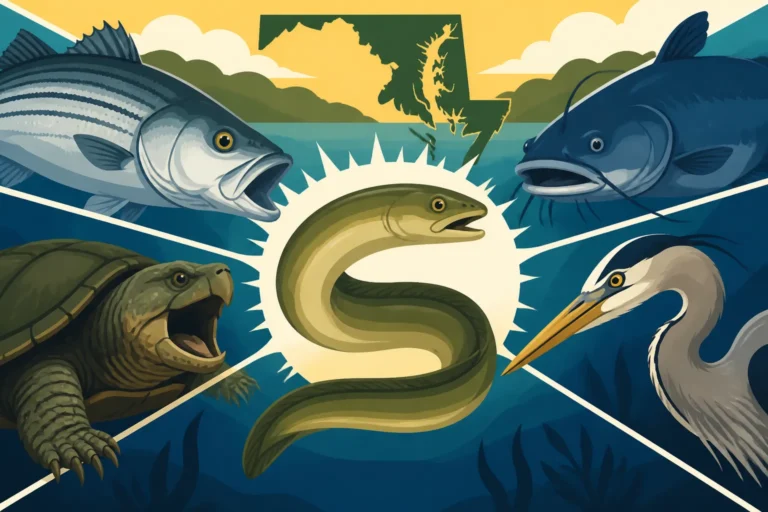
Larger fish, such as Striped Bass: Maryland's State Fish and various species of catfish, will readily prey on smaller eels. Beyond fish, eels are a key food source for various birds, including ospreys and bald eagles, especially when the eels are in shallower waters. Mammals like river otters also target eels. Furthermore, their scavenging habits mean they help clean up the river bottoms, consuming decaying organic matter and contributing to nutrient cycling. Despite often being seen as a nuisance, their ecological contributions are undeniable and necessary for healthy waterways. This complex relationship is further explored in articles like What Eats American Eels in the Chesapeake Bay?.
Angler Experiences and Management
Angler perceptions of eels are quite varied across Maryland. For many, hooking an eel is a frustrating experience. Their slimy bodies make them difficult to handle, and they have a habit of twisting and turning, often wrapping the line around themselves and making hook removal a chore. They're notorious for swallowing hooks deeply, leading to difficult releases. Some anglers consider them "bait thieves" because they can nibble away at bait intended for larger, more desirable game fish.
However, some anglers appreciate the fight an eel puts up, especially larger specimens, which can be surprisingly strong. A few even target them for food, as American Eels are considered a delicacy in various cultures and have firm, white, flavorful meat. For those who catch them regularly, ensuring your tackle box has a dedicated spot for de-hooking tools, readily sourced from Amazon or your local bait shop, is always a smart move. When it comes to management, there aren't specific catch limits or seasons for American Eels in Maryland, primarily because they aren't a traditional game fish. However, their populations have faced declines due to habitat loss, pollution, and barriers to migration (like dams). Maryland, along with other states, monitors eel populations closely and works on conservation efforts to ensure their future in our rivers. Always check the latest Maryland Fishing Regulations Guide, Where to Find It for any updates.
Distinguishing American Eels from Other Maryland Fish
At first glance, an American Eel might be mistaken for a snake or another elongated fish species. However, they possess several distinct characteristics that set them apart, especially from other fish found in Maryland's diverse aquatic environments. Understanding these unique features can help clear up any confusion and improve your overall knowledge of local wildlife.
Unique Characteristics and Appearance
The most striking feature of the American Eel is its long, slender, snake-like body, which gives it its common name. Unlike most fish that have clearly separate dorsal, caudal (tail), and anal fins, the eel's dorsal and anal fins are continuous, fusing seamlessly with its small, rounded caudal fin. This creates a single, undulating fringe along much of its back and belly, which aids in its serpentine swimming motion. They also possess small pectoral fins located just behind their head, but notably, they lack pelvic fins entirely. This unique fin structure is a key identifier.
In terms of coloration, adult American Eels in their "yellow eel" stage typically exhibit an olive-green to greenish-brown back and sides, fading to a yellowish or creamy white belly. This provides excellent camouflage in the muddy or vegetated river bottoms where they spend their days. Their skin is incredibly smooth, lacking visible scales, and is covered in a thick, protective layer of slime. This slime makes them incredibly slippery and difficult to hold, a fact any angler who has caught one can attest to! Their jaws are lined with numerous small, sharp teeth, perfect for grasping prey.
Common Misconceptions
Despite their snake-like appearance, it's crucial to remember that American Eels are indeed fish, not reptiles. They breathe through gills and have all the internal structures of a finned vertebrate. Another common misconception is that they are "electric eels." This is completely false; electric eels are a distinct species found exclusively in South America and possess specialized organs capable of generating powerful electric shocks. The American Eel, while certainly a lively catch, poses no electrical threat.
Anglers new to Maryland waters might also confuse eels with other elongated fish, most notably the Northern Snakehead in Maryland Waters. However, the two are quite different. While snakeheads also have a long body, they possess distinct, separate dorsal and anal fins, and their bodies are covered in prominent, snake-like scales. Their head is also much more flattened and reptilian in appearance compared to the eel's more pointed snout. If you're really keen on identifying species, a waterproof fish identification guide, often available on Amazon, can be a handy addition to your tackle box, helping you discern between these unique creatures. Remember, if you're fishing in Maryland, carrying a valid Maryland Fishing License Guide for 2026 is always your first step, regardless of what surprising catches you might encounter!
Disclaimer
This article is for general informational purposes only and does not constitute professional advice. Laws, prices and regulations vary by location and change over time. Consult a qualified professional for guidance on your specific situation.