Are Sturgeon Still Found in Maryland Waters?
It's incredibly disheartening when you hear whispers about magnificent fish disappearing from waters they once called home. For many anglers in Maryland, there's a deep-seated curiosity, and perhaps a touch of nostalgia, about the Atlantic sturgeon. These ancient, armored giants were once a significant part of the Chesapeake Bay's ecosystem, but their presence has dwindled dramatically. This guide will delve into whether these magnificent creatures still grace Maryland's waters, what their current status means for both the fish and the environment, and what every angler needs to know about encountering them.
The Ghostly Past: Sturgeon's Historical Presence in Maryland Waters
Imagine a time when the Chesapeake Bay and its major tributaries teemed with fish that could grow longer than a human and live for over 60 years. That's the reality of the Atlantic sturgeon in Maryland's past. These fish, often referred to as "living fossils" due to their prehistoric appearance, have been swimming in our waters for millions of years. They were a crucial part of the ecosystem, migrating up rivers like the Susquehanna, Nanticoke, and Potomac to spawn in freshwater before returning to the brackish and saline waters of the Bay and Atlantic Ocean.
A Rich History, A Rapid Decline
For centuries, indigenous peoples and early European settlers relied on sturgeon as a vital food source. Their flesh was prized, and their roe was highly sought after, leading to a booming caviar industry in the 19th century. This intense fishing pressure, combined with habitat destruction from dam construction, pollution, and dredging, delivered a devastating blow to sturgeon populations. Rivers that once saw hundreds, even thousands, of sturgeon returning to spawn began to see fewer and fewer. It wasn't just Maryland; this pattern was echoed along the entire Atlantic coast. The sheer scale of their harvest, without understanding their slow growth and delayed maturity, meant they couldn't reproduce fast enough to sustain their numbers. It’s a classic tale of unregulated exploitation leading to collapse, a somber reminder of how quickly even robust populations can vanish.
Why They Were So Important to the Bay Ecosystem
Beyond their commercial value, sturgeon played a unique role in the Bay. As bottom-feeders, they would root around in the substrate, stirring up sediments and consuming invertebrates. This activity helped cycle nutrients and impacted the benthic community, influencing the health of the entire ecosystem. Their sheer size also made them a significant predator, although their diet consists mostly of smaller, soft-bodied invertebrates. The decline of sturgeon signaled a broader degradation of river and Bay health, serving as an early warning bell for other species that might follow. Understanding their historical abundance helps us appreciate the loss and the potential for recovery.
The Present Reality: Are Atlantic Sturgeon Still Found in Maryland Waters?
The short answer is yes, Atlantic sturgeon are still found in Maryland waters, but they are exceptionally rare. These are not fish you're likely to catch by accident, or even by targeting them. Their populations are critically low, a stark shadow of their historical numbers. They are listed as an endangered species under the federal Endangered Species Act, a testament to just how dire their situation is along the entire East Coast, including our beloved Chesapeake Bay.
Federally Protected and Extremely Rare
Because of their endangered status, Atlantic sturgeon are fully protected. This isn't just a suggestion; it's a strict federal law. This means it is absolutely illegal to possess, harm, or harass an Atlantic sturgeon. If you happen to catch one – which would be an incredibly rare and exciting event – you must release it immediately and unharmed. These aren't like other fish where you might check a slot limit or a daily bag. There is no open season, no size limit for retention, and no legal way to keep one. The penalty for violating these protections can be severe, involving hefty fines and even imprisonment, underscoring the serious nature of their conservation. Understanding these strict rules is paramount for any angler. Is It Legal to Catch Atlantic Sturgeon in Maryland? details this further.
Where and When They Might Be Encountered
While rare, sightings and accidental catches of Atlantic sturgeon do occur in Maryland. They are most likely to be found in the deeper channels of the Chesapeake Bay itself, particularly during their migratory periods. They also make their way into the lower stretches of major tributaries such as the Nanticoke, Choptank, and Potomac rivers. Juvenile sturgeon might also be found in these areas, as some rivers are still thought to host remnant spawning populations or serve as nursery grounds.
Anglers fishing for other species, especially those bottom-fishing with bait in deeper areas, are the most likely to have an encounter. However, even for experienced Bay captains who spend countless hours on the water, seeing a sturgeon is an event talked about for years. They are truly living ghosts of the Bay's past, and any encounter should be treated with utmost respect and caution. While you can find countless fishing guides and tools on Amazon for common species, you won't find one for targeting sturgeon, and rightly so.
Identifying Sturgeon and Reporting Sightings
Given their rarity and protected status, knowing how to identify an Atlantic sturgeon is crucial for any angler in Maryland. Misidentification could lead to inadvertently harming one, or missing a valuable opportunity to contribute to scientific monitoring efforts. They have a very distinct appearance that sets them apart from other fish in the Bay.
Key Identification Features
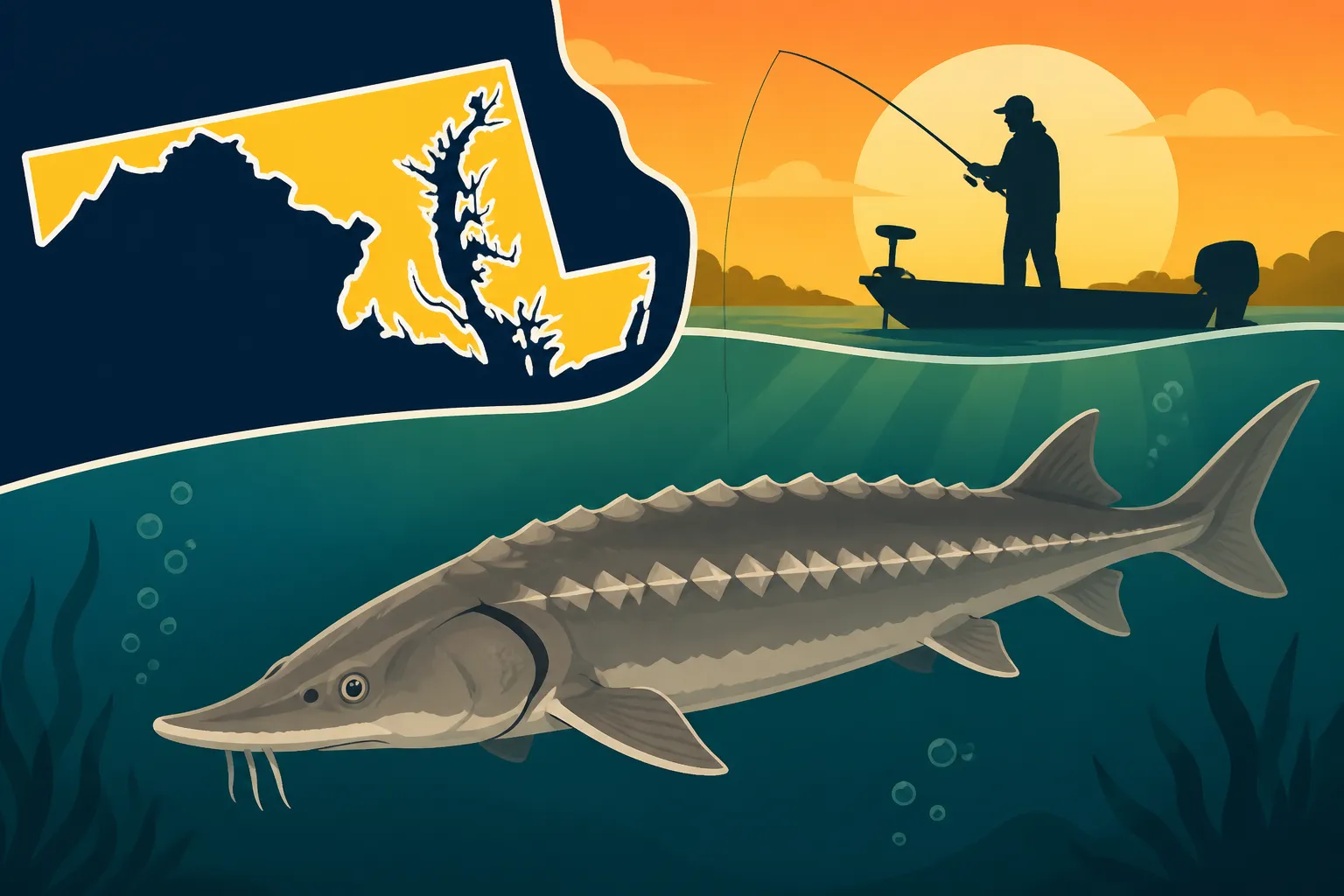
Atlantic sturgeon are truly unique in their physical characteristics. They possess five rows of bony plates, called scutes, running along their body instead of scales. These scutes are particularly prominent on young sturgeon, becoming smoother as the fish ages. Their body shape is long and slender, with a pointed snout and a subterminal mouth (meaning it's located on the underside of the head, perfect for grubbing along the bottom). They also have four barbels (whisker-like sensory organs) in front of their mouth. Their coloring typically ranges from olive-brown to bluish-black on their back, fading to a white or yellowish belly.
Here's a quick comparison to help distinguish them from other large fish you might encounter:
| Feature | Atlantic Sturgeon | Blue Catfish | Flathead Catfish |
|---|---|---|---|
| Body Covering | 5 rows of prominent bony scutes (no scales) | Smooth, scaleless skin | Smooth, scaleless skin |
| Snout/Head | Pointed, shovel-like snout | Broad head, often with a slight humped appearance | Flat, wide head |
| Mouth | Subterminal (underneath snout), protrusible | Terminal or slightly subterminal, wide | Terminal, very wide, often a grimace |
| Barbels | 4 short barbels in front of mouth | 8 barbels around mouth (long and slender) | 8 barbels around mouth (long and slender) |
| Tail Fin | Heterocercal (upper lobe longer than lower) | Forked tail | Squared or slightly emarginate tail |
| Dorsal Fin | Set far back on body, single | Single, tall, often with a serrated spine | Single, relatively short |
| Coloration | Olive-brown to bluish-black back, white belly | Silvery to dark blue-gray, white belly | Mottled brown/yellow, often with darker spots |
| Size (Adult) | Can exceed 8 feet, hundreds of pounds | Can exceed 5 feet, over 100 pounds | Can exceed 5 feet, over 100 pounds |
| Legal Status | Federally Endangered (NO POSSESSION) | Invasive (no limit on possession, encouraged harvest) | Invasive (no limit on possession, encouraged harvest) |
It's important to differentiate them from species like the Maryland Blue Catfish, an Invasive Giant or the northern snakehead, both of which are also large, but pose different conservation challenges.
What to Do If You Encounter One
Should you be incredibly fortunate to catch an Atlantic sturgeon:
- Do NOT remove it from the water. Keeping it submerged helps it breathe and reduces stress.
- Cut the line as close to the hook as safely possible. Avoid handling the fish more than absolutely necessary.
- Do NOT attempt to net it or bring it onto the boat. These actions can injure the fish, especially its delicate mouth and gills.
- Take a quick photo if you can, without delaying its release or stressing the fish. This can be invaluable for scientists.
- Immediately report the sighting. The Maryland Department of Natural Resources (DNR) wants to know about these encounters. You can typically find a contact number for their fisheries division on their official website or within their annual fishing guide. Reporting helps researchers track their movements and understand population trends. Consider keeping a waterproof notebook or a dedicated fishing app on your phone (many available on Amazon work great for logging catches and notes) to record details like location, time, and estimated size. For very important sightings, like a sturgeon, a quick call to the Maryland Fisheries Complaint and Poaching Hotline would be appropriate, explaining it's a sturgeon sighting for research, not a complaint.
Conservation Efforts and Hope for the Future
The journey to recover Atlantic sturgeon populations is a long and challenging one, but it's not without hope. Conservation efforts are multifaceted, focusing on habitat restoration, strict protections, and scientific research to better understand these enigmatic fish.
Restoring Critical Habitat
A major hurdle for sturgeon recovery is the degradation and blockage of their historical spawning grounds. Dams, like the Conowingo Dam on the Susquehanna River, have historically blocked their access to vital freshwater areas. Efforts are underway to improve fish passage where possible, and to restore water quality in the rivers and the Bay. Reducing pollution and sediment runoff is critical not just for sturgeon, but for the entire aquatic food web, including forage fish like menhaden, which are so important to the Bay's health. Why Are Menhaden Important Bait Fish in the Chesapeake Bay? is a good example of how interconnected these species are.
Research and Monitoring
Scientists are actively studying Atlantic sturgeon using various methods, including acoustic tagging, genetic analysis, and monitoring incidental captures. Acoustic tags allow researchers to track individual sturgeon as they move through the Bay and along the coast, providing valuable insights into their migration patterns and habitat use. Genetic studies help determine if different populations are distinct and where they originate, informing conservation strategies. Every reported sighting, even incidental ones, contributes to this vital data collection. For the casual angler, knowing how to properly release and report a sturgeon is their biggest contribution to these efforts. You can often find informational posters or brochures at local tackle shops or online (some even available via print-on-demand from Amazon) that illustrate safe handling and reporting procedures.
Angler's Role in Sturgeon Recovery
As anglers, we have a critical role to play in the recovery of Atlantic sturgeon. It starts with education – understanding their protected status and knowing how to identify them correctly. It extends to practicing responsible catch and release, not just for sturgeon but for all species, to ensure healthy fish populations for generations to come. Respecting closed seasons, size limits, and species-specific regulations is vital for the overall health of Maryland's fisheries. Maryland Fishing License Penalties for Violations highlights the importance of adhering to these rules. By being good stewards of the environment and our aquatic resources, we contribute to a future where these ancient giants might once again thrive in Maryland's vibrant waters.
Disclaimer
This article is for general informational purposes only and does not constitute professional advice. Laws, prices and regulations vary by location and change over time. Consult a qualified professional for guidance on your specific situation.