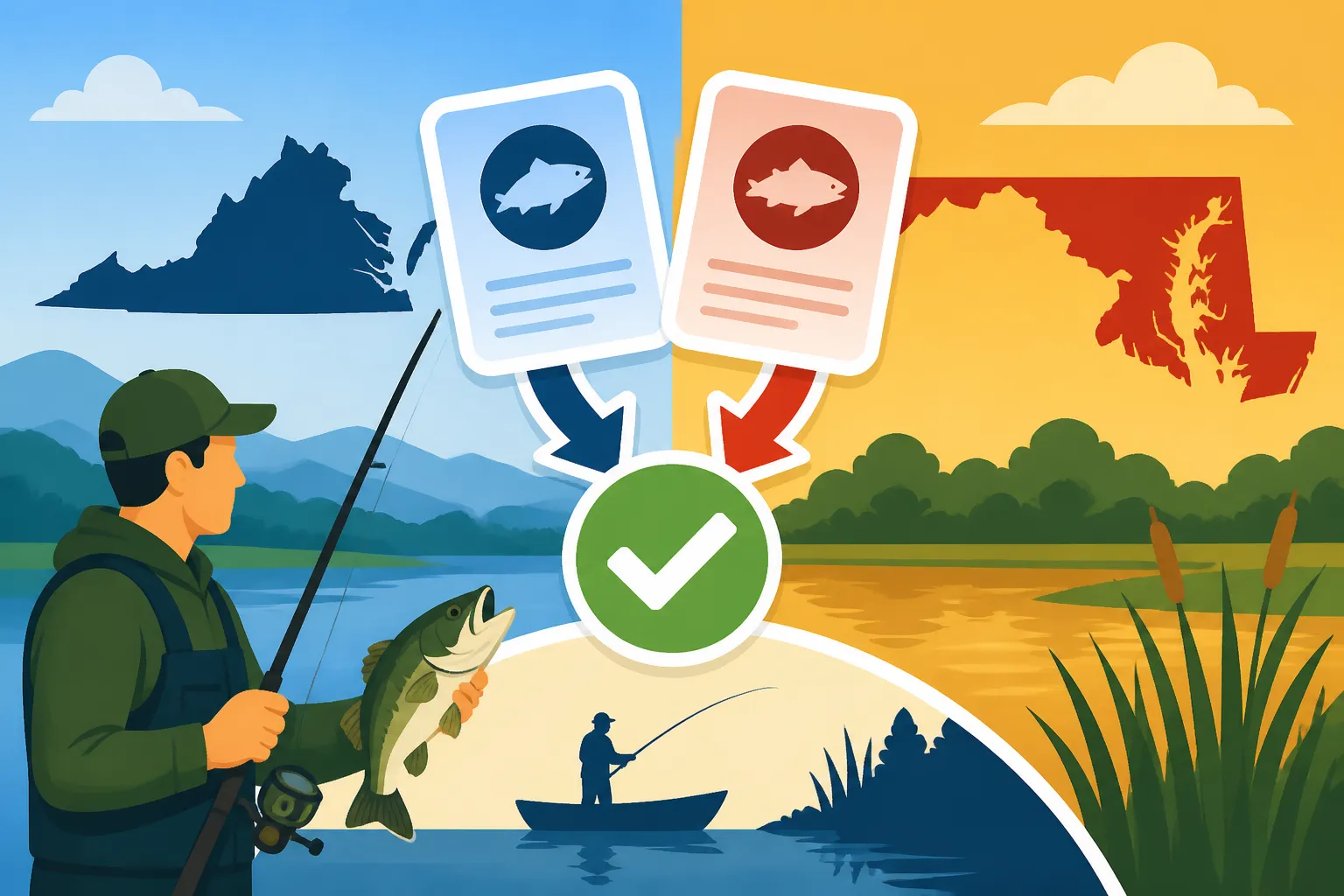
Combining a Virginia and Maryland Fishing License
It's incredibly frustrating when you're standing on the water's edge, rod in hand, ready for a fantastic day of fishing, but a nagging doubt creeps in: Do I have the right license for these waters? Especially when you're navigating state lines like those between Maryland and Virginia, the rules can feel like a tangled mess of red tape. This comprehensive guide is here to unravel that confusion, helping you understand the specifics of combining, or rather, properly acquiring, the necessary fishing licenses to enjoy both Maryland and Virginia waters without a hitch.
The Tricky Territory of Border Water Fishing
Anglers often dream of seamless access to all waterways, but state lines can turn that dream into a bureaucratic nightmare. The reality of fishing along the borders of Maryland and Virginia often means grappling with distinct regulations and licenses, which can be a real buzzkill if you're not prepared. Many assume that if you have a license for one state, especially for a shared body of water like the Chesapeake Bay or the Potomac River, you're automatically covered everywhere. This couldn't be further from the truth, and this common misconception can lead to unwelcome encounters with enforcement officers.
The Myth of the Universal License
It's easy to fall into the trap of thinking one license should cover it all, especially when a river flows from one state into another, or a bay spans multiple jurisdictions. You might hear stories from friends or read old forum posts that suggest some sort of "gentlemen's agreement" or universal reciprocity, but these tales are often outdated or simply incorrect. The truth is, each state fiercely guards its natural resources, and the licensing fees contribute significantly to their conservation efforts. This means they want their slice of the pie, even if you’re only crossing an invisible line in the water.
The expectation of a universal license is particularly strong when you consider how connected the waterways feel. You might be fishing the lower Potomac, catching a feisty blue catfish, and not even realize that a slight drift or a change in your casting direction could put you squarely in a different state's jurisdiction. This isn't just about avoiding a fine; it's about respecting the different management strategies each state employs to protect its fish populations and angling traditions.
Geographical Challenges and Invisible Lines
Pinpointing exact state lines in the middle of a river or a vast bay can be incredibly challenging, even with modern GPS technology. For instance, the main stem of the Potomac River below the low-water mark on the Virginia side is actually considered Maryland territory, a historical quirk that surprises many. This means that if you launch your boat from a Virginia ramp and fish towards the Maryland shore, you might technically be in Maryland waters, even if you feel like you're closer to Virginia. Similarly, navigating the vast expanse of the Chesapeake Bay can be confusing. While it's one continuous body of water, imaginary lines divide it into separate management zones, each with its own licensing requirements and sometimes even differing catch limits.
These invisible boundaries aren't just for show. They dictate which state's Department of Natural Resources (DNR) has jurisdiction, and therefore, which state's license you need. Understanding these geographical nuances is the first crucial step to ensure you're legally compliant and can enjoy your fishing trip without constantly looking over your shoulder. It’s not always intuitive, and what might seem like a small bend in a creek can legally be a completely different jurisdiction.
Maryland and Virginia's Distinct Licensing Structures
Before we dive into the specifics of shared waters, it's essential to understand that Maryland and Virginia operate under their own unique licensing frameworks. They aren't designed to be easily interchangeable, and each has its own set of rules, endorsements, and exceptions. Knowing the basics of each state's system will help you identify what you need, rather than just guessing.
Maryland's License Structure
Maryland's fishing license system generally separates waters into "tidal" and "nontidal" categories, each with its own requirements. If you plan to fish in freshwater lakes, ponds, or rivers above the tidal influence, you'll need a Maryland Nontidal Fishing License. For anglers targeting species in the Chesapeake Bay or its tidal tributaries, or along the Atlantic Ocean coast, a Maryland Bay and Coastal Sport Fishing License (often just called a Bay license) is required. There's also an option to get a Consolidated Sport Fishing License, which covers both tidal and nontidal waters, offering convenience for those who fish across diverse environments.
For residents, these licenses are fairly straightforward, but nonresidents will find higher price points. Maryland even has specific endorsements, like the Trout Stamp if you plan to fish for trout in designated waters, or a Two-Pole Endorsement if you want to use more than one line. It’s crucial to check the specific requirements, as even something as simple as fishing from a pier might have different rules. For a deeper dive into these distinctions, you might find our guide on Maryland Nontidal vs Tidal Fishing License, Explained particularly helpful.
Virginia's License Structure
Virginia also operates with a similar division, generally requiring a Freshwater Fishing License for inland waters and a Saltwater Fishing License for coastal and tidal waters, including the Virginia portion of the Chesapeake Bay. They also offer a comprehensive "Fishing License" that covers both fresh and saltwater for residents, similar to Maryland's consolidated option. However, Virginia has some specific nuances that are critical for cross-border anglers, especially concerning the Potomac River. Unlike Maryland, Virginia has some private and public ponds and lakes where a state license may not be required if you have permission from the landowner or if it's a privately stocked fee-fishing facility.
Virginia also has various special permits and stamps, such as a trout license for designated trout waters, and specific permits for particular types of fishing gear. When looking at Virginia's license options, it's important to differentiate between general licenses and those that cover specific bodies of water or activities. For example, some pier fishing might be covered by a blanket permit held by the pier owner, but you should always verify this before casting your line.
Navigating Shared Waters: Specific Rules and Agreements
This is where the rubber meets the road. Shared waterways like the Potomac River, the Pocomoke River, and the open Atlantic Ocean create unique jurisdictional challenges. Fortunately, some agreements are in place, but understanding their limits is key to staying legal.
The Potomac River Fisheries Commission (PRFC) License
Perhaps the most significant and often confusing aspect of fishing on the Maryland-Virginia border is the Potomac River. The Potomac River below the District of Columbia is managed by the Potomac River Fisheries Commission (PRFC). This isn't a state agency but an interstate commission created by a compact between Maryland and Virginia. To fish the main stem of the Potomac River (from the fall line at Chain Bridge down to the Chesapeake Bay), you do not need a separate Maryland or Virginia state tidal fishing license. Instead, you need a PRFC fishing license. This license is explicitly designed to cover fishing in the tidal Potomac River.
It’s important to note that a PRFC license is only valid for the main stem of the Potomac River and its embayments (like Mattawoman Creek, Piscataway Creek, etc.) up to the first upstream bridge or dam where tidal influence stops. It does not cover the tributaries that flow into the Potomac if those tributaries are entirely within Maryland or Virginia. For example, if you fish a small creek entirely on the Maryland side that flows into the Potomac, you would need a Maryland tidal license. If you're unsure where the PRFC jurisdiction ends, always consult a map or the PRFC regulations. You can find much more detailed information on this topic in our article, What Is the Potomac River Fisheries Commission License?.
Pocomoke River and Atlantic Ocean Waters
Beyond the Potomac, there are other areas where Maryland and Virginia waters meet. The Pocomoke River, for instance, flows through both states before emptying into the Chesapeake Bay. Here, the rules are generally simpler: if you are fishing in the Maryland portion of the Pocomoke River, you need a Maryland fishing license. If you are in the Virginia portion, you need a Virginia license. There isn't a joint commission like the PRFC for the Pocomoke, so it truly depends on which side of the invisible line you are casting your line.
When it comes to the Atlantic Ocean, things are a bit more straightforward, yet still require attention. Generally, if you are fishing in Maryland state waters (typically out to three miles from shore), you need a Maryland Bay and Coastal Sport Fishing License. The same applies to Virginia: if you're in Virginia state waters, you need a Virginia saltwater license. Offshore, in federal waters (beyond three miles), state licenses generally apply if you depart from and return to that state's port. However, federal permits might be required for certain species or vessels, so always verify if you're heading far offshore. It's rare for anglers to inadvertently cross state lines in the open ocean in a way that impacts their state recreational fishing license, but it's good to be aware.
Interstate Reciprocity and Its Limitations
While a full "combination" license doesn't exist for all Maryland and Virginia waters, there are instances of limited reciprocity. The PRFC license for the Potomac is the prime example, acting as a shared, reciprocal license for that specific waterway. However, this is largely an exception, not the rule. Generally, a Maryland state fishing license does not grant you permission to fish in Virginia's Chesapeake Bay waters or vice-versa, nor does it cover inland freshwater bodies in the other state.
It's tempting to think that since the Chesapeake Bay is one large ecosystem, a license from either state should grant access to the whole thing. Unfortunately, state sovereignty means that each state manages its portion of the Bay independently. This means that if you launch your boat in Annapolis, Maryland, and motor down to the lower Bay near Virginia Beach, Virginia, and decide to drop a line, you'd better have a Virginia saltwater fishing license in your possession. Similarly, if a Virginia angler cruises north into Maryland's portion of the Bay, a Maryland Bay license would be required. This is why many dedicated Bay anglers who fish widely across the entire estuary choose to purchase licenses for both states, if their primary fishing grounds span both jurisdictions.
Practical Tips for Cross-Border Anglers
Navigating these regulations can feel overwhelming, but a few practical steps can help ensure you're always on the right side of the law and can focus on the fishing, not the fines.
Planning Your Trip: Research is Key
The absolute best advice for any cross-border angler is to do your homework before you even hook up the boat or pack your tackle box. This means thoroughly researching the specific body of water you intend to fish, noting where state lines might be, and understanding the jurisdiction. A good quality waterproof map that clearly delineates state boundaries can be an invaluable tool; you can often find excellent laminated options on Amazon or at local bait and tackle shops.
Check the current year's fishing regulations for both Maryland and Virginia, paying close attention to any special rules for border waters. These regulations are typically available online through each state's Department of Natural Resources (DNR) website. For Maryland, you can often find the comprehensive guide explained in our post about Maryland's DNR Fishing and Boating Guide, Explained. It's not just about licenses; catch limits, size restrictions, and season dates can also differ between states, even for the same species. Imagine the heartbreak of catching a trophy striped bass, only to find it's undersized for the state you're currently in, even if it would have been legal just a few miles away.
Purchasing the Right Licenses
Once you've determined which licenses you need, the next step is to acquire them. Both Maryland and Virginia offer convenient online purchasing options through their respective DNR websites. This is often the quickest and easiest way, allowing you to print a temporary license immediately. Alternatively, you can buy licenses in person at various bait and tackle shops, sporting goods stores, and county clerk offices. Our guide on How to Buy a Maryland Fishing License provides step-by-step instructions for the Old Line State.
If you find yourself needing both a Maryland and a Virginia license for your multi-state angling adventures, consider what type of license makes the most sense. For example, if you're a nonresident planning a week-long trip that might span both states, looking into options like the Maryland 7-Day Fishing License Options could be more cost-effective than an annual nonresident license for each state. Always ensure that the license you purchase specifically covers the type of water (tidal/nontidal, freshwater/saltwater) you intend to fish. Don't forget any necessary stamps or endorsements like a Maryland Trout Stamp if you venture into trout waters.
Keeping Up-to-Date with Regulations
Fishing regulations are not set in stone; they can and do change. Sometimes these changes are seasonal, sometimes they're annual, and sometimes emergency closures or rule adjustments are implemented mid-season due to conservation needs or biological assessments. This is especially true for highly managed species like striped bass, where rules are frequently adjusted. Our resource on How Often Maryland Updates Its Fishing Regulations can give you an idea of the frequency of these changes.
Before each fishing trip, especially if it's been a while since your last outing or if you're going to a new area, take a few minutes to quickly check the most current regulations for both states. Many DNR websites offer email or text alerts for significant changes, which can be an excellent way to stay informed. A quick search on your phone or a look at a fishing app could save you a significant fine. Also, don't rely solely on what a friend tells you; verify information with official sources.
Consequences of Fishing Without the Right License
While it might seem like a minor oversight, fishing without the proper license in Maryland or Virginia can lead to serious repercussions. Enforcement officers take their duties seriously, and ignorance of the law is rarely an acceptable excuse.
Common Violations and Misunderstandings
One of the most common violations for cross-border anglers is simply not having the correct state's license for the water they are in. This often happens in the Potomac River, where anglers mistakenly believe their Maryland or Virginia state tidal license covers the mainstem, rather than needing a PRFC license. Another frequent issue arises when anglers, particularly those in boats, drift across an invisible state line in the Chesapeake Bay without realizing they are now in different jurisdiction, with different licensing requirements.
Beyond just the license, violations often include not adhering to the correct catch limits, size limits, or season dates for the specific state you're in. For example, Maryland Striped Bass Season and Rockfish Rules might differ significantly from Virginia's rules for the same species, leading to illegal possession if you're not careful. Even if you hold a valid license from one state, if you're in the other state's waters and don't have their license, you are violating the law.
Enforcement and Penalties
When caught fishing without the correct license, or violating other regulations, the consequences can range from a warning to significant fines, confiscation of your catch, and even seizure of your fishing gear. For example, Maryland Fishing License Penalties for Violations can include monetary fines that easily exceed the cost of an annual license, plus court costs. Virginia has similar penalty structures. These fines can quickly add up, turning what should have been a relaxing day on the water into a very expensive lesson.
In some cases, repeated violations or particularly egregious offenses could lead to the suspension of your fishing privileges. Enforcement officers from both states, as well as the PRFC, actively patrol their waters. They are trained to identify common hot spots for violations and conduct routine checks. It's not uncommon for them to approach boats or shore anglers to ask for licenses and inspect catches. Having all your documentation in order, readily accessible, perhaps in a waterproof pouch that you picked up from Amazon, will make these encounters quick and painless.
Here's a quick overview to help you visualize the common scenarios:
| Fishing Location | Primary License Required (MD Resident) | Primary License Required (VA Resident) | Important Notes |
|---|---|---|---|
| Main Stem Potomac River (Tidal) | PRFC License | PRFC License | This license covers the main stem and its embayments up to the first upstream bridge/dam. Neither MD nor VA state tidal licenses are valid here. |
| MD Chesapeake Bay & Tributaries | MD Bay & Coastal Sport License | MD Bay & Coastal Sport License | If you are fishing in Maryland's portion of the Chesapeake Bay or its tidal rivers like the Patuxent or Choptank, you need a Maryland license. |
| VA Chesapeake Bay & Tributaries | VA Saltwater License | VA Saltwater License | If you are fishing in Virginia's portion of the Chesapeake Bay or its tidal rivers like the James or York, you need a Virginia saltwater license. |
| MD Nontidal Waters (Lakes/Rivers) | MD Nontidal Fishing License | MD Nontidal Fishing License | For freshwater lakes and rivers entirely within Maryland, like Deep Creek Lake or the upper Gunpowder River. |
| VA Freshwater Waters (Lakes/Rivers) | VA Freshwater Fishing License | VA Freshwater Fishing License | For freshwater lakes and rivers entirely within Virginia, like Lake Anna or the upper James River. |
| Atlantic Ocean (MD State Waters) | MD Bay & Coastal Sport License | MD Bay & Coastal Sport License | Out to 3 miles from the Maryland coast. |
| Atlantic Ocean (VA State Waters) | VA Saltwater License | VA Saltwater License | Out to 3 miles from the Virginia coast. |
| Pocomoke River (MD Portion) | MD Bay & Coastal Sport License | MD Bay & Coastal Sport License | The Pocomoke River flows through both states; apply the appropriate state license for the portion you are fishing. |
| Pocomoke River (VA Portion) | VA Saltwater License | VA Saltwater License | The Pocomoke River flows through both states; apply the appropriate state license for the portion you are fishing. |
| Fishing from a Charter Boat | Often covered by charter license | Often covered by charter license | Passengers on a properly licensed charter boat typically do not need their own individual license, as the vessel's commercial license covers everyone. Always confirm with your captain beforehand. See Maryland Charter Boat License Coverage for Passengers for more. |
The Value of Being Prepared
Ultimately, the small investment in time and money to secure the correct licenses for both Maryland and Virginia, if your fishing plans cross state lines, is well worth it. Not only does it protect you from legal trouble, but it also ensures you're contributing to the conservation efforts of both states. These license fees directly fund fisheries management, habitat restoration, and enforcement programs that help maintain healthy fish populations for everyone to enjoy.
Think of it as peace of mind. You can focus on the thrill of the catch, the beauty of the Chesapeake Bay, or the tranquility of a freshwater stream, knowing you're fully compliant. Many serious anglers who frequent both states simply buy both annual licenses, or the PRFC license in addition to a single state license, to avoid any doubt. For instance, if you're a Maryland resident who often fishes the main stem of the Potomac and also the Maryland portions of the Chesapeake Bay for species like blue catfish, you'd likely need a PRFC license AND a Maryland Bay & Coastal Sport Fishing License. Before your next big adventure, double-check your licenses, maybe grab a new fishing journal from Amazon to keep track of your catches, and enjoy the incredible fishing opportunities that both Maryland and Virginia have to offer.
Disclaimer
Please remember that fishing regulations are subject to change by the Maryland Department of Natural Resources (DNR), Virginia Department of Wildlife Resources (DWR), and the Potomac River Fisheries Commission (PRFC). This guide is intended for informational purposes only and should not replace consulting the official and most current regulations published by these agencies. Always verify the latest rules before you go fishing.