Maryland Fishing License for Out-of-State College Students
Trying to figure out Maryland's fishing license rules when you're an out-of-state college student can feel like trying to untangle a particularly stubborn fishing knot. You're living here for school, but is that enough to make you a "resident" in the eyes of the Maryland Department of Natural Resources (DNR)? It's a common point of confusion that can lead to unnecessary costs or, even worse, unknowingly breaking the rules. This comprehensive guide is here to clear up the murky waters, helping you understand your options and ensure you're legally ready to cast a line in Maryland's diverse fishing spots.
Understanding Maryland's Residency Rules for Fishing Licenses
One of the biggest hurdles for out-of-state college students eyeing Maryland's plentiful fishing opportunities is understanding whether they qualify for a resident fishing license. It seems straightforward – you live here, right? You pay rent, you go to class, you're part of the community. However, for licensing purposes, the definition of "residency" can be surprisingly specific and often differs from how you might define it in your daily life. It’s not just about where you lay your head down at night while school is in session; it often involves a longer-term commitment or specific documentation.
Defining "Residency" for Fishing Licenses
When it comes to fishing licenses, Maryland DNR generally defines a "resident" as someone who has lived in the state continuously for at least six months immediately prior to applying for a license, and whose true fixed and permanent home and principal establishment are in Maryland. This definition is crucial because it sets the stage for whether you pay the typically lower resident rates or the higher nonresident fees. For many college students, especially those who maintain a permanent address with their parents in another state, meeting this six-month continuous residency requirement with the intent to remain permanently in Maryland can be challenging. It's not enough to simply be enrolled in a university; the state looks for a demonstrated commitment to Maryland as your primary domicile.
For example, if you moved to Maryland in August for the start of the fall semester, and you typically return to your family home in Virginia or Pennsylvania for winter and summer breaks, you likely won't meet the "fixed and permanent home" criteria. Your enrollment at a University of Maryland campus or Johns Hopkins, while making you a temporary resident for academic purposes, usually doesn't automatically grant you fishing license residency status. The Maryland DNR wants to see evidence that Maryland is the place you intend to reside indefinitely, not just for the duration of your degree. This distinction is paramount, as misrepresenting your residency status can lead to fines and penalties, which is the last thing any student needs.
Special Considerations for College Enrollment
While college enrollment itself doesn't automatically confer resident fishing license status, there are some nuances that might apply. If you happen to be a student who has actually moved to Maryland with the genuine intent to make it your permanent home, even if your enrollment brought you here, you might qualify. This would mean establishing significant ties: transferring your driver's license, registering your vehicle in Maryland, changing your voter registration, and ideally, having been in the state for that requisite six-month period without returning to your previous state of residence for extended periods.
However, for the vast majority of out-of-state college students, maintaining legal residency in their home state is the norm. Their "permanent home" is still with their parents or guardians outside Maryland, and they return there during breaks. In such cases, despite living in a dorm or off-campus apartment for nine months of the year, they are considered nonresidents for fishing license purposes. The rules are designed to prevent people from temporarily establishing residency simply to gain access to cheaper licenses or other state benefits. It might feel a bit unfair when you're contributing to the local economy and community, but those are the parameters set by the Maryland DNR to protect their resident resources. Therefore, it's safest to assume you'll need to purchase a nonresident license unless you have taken concrete, official steps to establish permanent Maryland residency beyond just attending college.
Maryland Fishing License Options for Non-Resident Students
So, if you're an out-of-state college student and the residency rules mean you'll likely be considered a nonresident for fishing, don't fret! Maryland offers several convenient options that cater to various fishing habits, from the dedicated angler who fishes every weekend to someone just looking to cast a line a few times during a semester. Understanding these options is key to picking the most cost-effective and appropriate license for your angling adventures.
Annual Nonresident Licenses
For the out-of-state college student who plans to fish frequently throughout the academic year, an annual nonresident fishing license is often the best value. This license typically covers you for a full year from the date of purchase or for the calendar year, depending on the specific type. For instance, a Maryland Nonresident Annual Nontidal License Cost will grant you access to all of Maryland's freshwater lakes, rivers, and ponds – perfect for those studying near places like Loch Raven Reservoir or Deep Creek Lake. If your campus is closer to the Chesapeake Bay, like in Annapolis or Salisbury, and you plan to fish for species like striped bass or white perch, you would need a Maryland Nonresident Chesapeake Bay License Cost for nonresidents.
The benefit of an annual license is peace of mind. You buy it once, and you're covered without having to worry about expiration dates for every spontaneous fishing trip. This makes it ideal for students who might keep a rod and reel in their car for quick trips after classes or on weekends. While the initial outlay is higher than a short-term license, the per-day cost drops significantly if you fish more than a handful of times. It's a straightforward option that ensures you're always ready when the bite is on.
Short-Term and Temporary Options
For students who only plan to fish occasionally, or perhaps are just trying it out for the first time with friends, Maryland's short-term nonresident fishing licenses are incredibly flexible and cost-effective. These licenses are designed for temporary visitors and are perfect for a weekend outing or a longer holiday break. For example, a Maryland 3-Day Fishing License Cost for nonresidents is a popular choice for short trips. This license provides coverage for three consecutive days, allowing you to enjoy a full weekend of fishing without committing to an annual pass.
There are also Maryland 7-Day Fishing License Options available, which are fantastic if your family comes to visit, or if you're heading out on a week-long spring break fishing adventure within the state. These temporary licenses can be purchased online or from license agents, making them easy to acquire right before your trip. The downside, of course, is that if you find yourself wanting to fish more often, the cumulative cost of several short-term licenses can quickly surpass the price of an annual license. It's worth doing a quick calculation: if you anticipate fishing more than five or six separate short trips within a year, an annual license might actually save you money in the long run.
Costs and Purchasing Your License
Understanding the different types of licenses is only half the battle; knowing what they cost and where to purchase them efficiently is just as important. For out-of-state college students, budget is often a primary concern, so choosing the right license at the right price point is critical. Maryland DNR has streamlined the purchasing process to make it as easy as possible, whether you prefer digital or in-person transactions.
Comparing Nonresident License Costs
The cost of a Maryland fishing license for nonresidents will vary depending on the type and duration you choose. As we've discussed, annual licenses are generally more expensive upfront but offer better long-term value for frequent anglers, while short-term options are perfect for occasional outings.
Here’s a simplified breakdown to help illustrate the typical differences, keeping in mind that exact figures can change, so always check the current Maryland DNR website.
| License Type | Estimated Cost (Nonresident) | Coverage | Best For |
|---|---|---|---|
| Annual Nontidal | ~$30-40 | Freshwater (lakes, rivers, ponds) | Frequent freshwater anglers |
| Annual Chesapeake Bay Sport | ~$20-30 | Tidal (Chesapeake Bay & tributaries) | Frequent saltwater/bay anglers |
| Annual Consolidated | ~$50-60 | Freshwater & Tidal (all MD waters) | Frequent anglers in both types of water |
| 3-Day Nontidal | ~$7-10 | Freshwater (3 consecutive days) | Occasional freshwater trips (e.g., a weekend) |
| 7-Day Chesapeake Bay Sport | ~$12-15 | Tidal (7 consecutive days) | Week-long bay fishing trips |
| Annual Trout Stamp | ~$10-15 (add-on) | Required for keeping trout | Anglers targeting or keeping trout |
Note: These are approximate costs and can be subject to change. Always verify current prices on the official Maryland DNR website.
As you can see, choosing the Maryland Consolidated License That Covers Hunting and Fishing can be the most economical if you plan to enjoy both activities. For fishing alone, considering which waters you'll primarily fish (tidal or nontidal) helps you avoid overpaying. For example, if you're only planning to fish the many public fishing piers along the Chesapeake Bay for white perch, a Chesapeake Bay Sport Fishing License will be sufficient, and you won't need the Nontidal license.
Where and How to Buy Your License
The good news is that Maryland has made purchasing fishing licenses incredibly convenient, no matter where you are or what time of day it is. You have several options at your fingertips, which is a real blessing when you're juggling classes and other student responsibilities.
The easiest and most common way for many students to get their license is by Buying a Maryland Fishing License Online. The Maryland DNR website provides a secure and user-friendly portal where you can select your license type, provide your information, and pay with a credit card. Your license is often available to print immediately or can be saved digitally on your phone. This method is fantastic because you can do it anytime, anywhere – perfect for a late-night study break when you suddenly decide to go fishing the next day. You can generally also check if you Can You Buy a Maryland Fishing License on Your Phone? through a dedicated app or mobile-optimized site, offering even more flexibility.
If you prefer a more traditional route or need some in-person assistance, there are plenty of places Where to Buy a Maryland Fishing License in Person. This includes many bait and tackle shops throughout the state, sporting goods stores, and even some clerk's offices. These locations often have knowledgeable staff who can answer specific questions about license types or local fishing regulations. This can be particularly helpful if you're new to the area and want local insights. Make sure to bring a valid form of identification when purchasing in person. No matter how you choose to buy it, remember that possessing a valid license is non-negotiable, and failing to do so can result in Maryland Fishing License Penalties for Violations.
Navigating Tidal vs. Nontidal Waters
Maryland's diverse geography offers an incredible array of fishing environments, from the calm, tree-lined streams of Western Maryland to the vast, salty expanse of the Chesapeake Bay and its tributaries. This variety is fantastic for anglers, but it also means understanding a crucial distinction for your fishing license: tidal versus nontidal waters. Many out-of-state students, particularly if they come from states with simpler licensing structures, can easily get confused by this separation. Yet, knowing the difference is essential, as the wrong license could leave you vulnerable to fines.
Distinguishing Tidal and Nontidal Waters
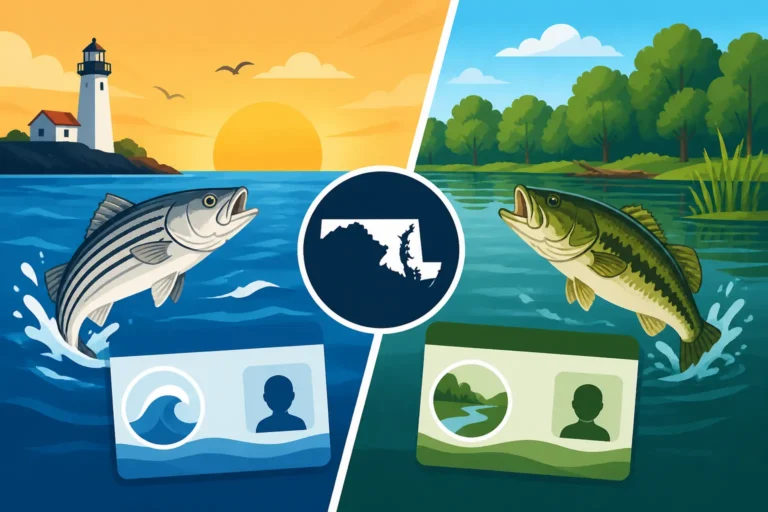
The simplest way to think about it is this: tidal waters are those influenced by the ocean's tides, primarily the Chesapeake Bay and all its rivers and creeks up to specific demarcation lines. Think of the Patuxent River, the Severn, the Choptank, and, of course, the main stem of the Bay itself. When you fish in these areas, you're looking for species like striped bass (rockfish), bluefish, croaker, and white perch during their bay runs. Nontidal waters, on the other hand, are freshwater bodies that are not affected by tides. These include many lakes (like Deep Creek Lake, Loch Raven Reservoir), ponds, and streams (such as the Gunpowder River above the tidal influence). Here, you'll typically find largemouth bass, smallmouth bass, trout, and various panfish.
The confusion often arises because some rivers, like the Patuxent or the Potomac, have both tidal and nontidal sections. For example, if you're fishing the upper Potomac River for smallmouth bass, you'll generally be in nontidal waters. But if you're further downstream, near the mouth where it empties into the Chesapeake, you're firmly in tidal territory, even though it's still a "river." The Maryland Nontidal vs Tidal Fishing License, Explained article goes into more detail, but as a rule of thumb, if you're on the Chesapeake Bay or any river directly connected to it that rises and falls with the tide, you need a tidal license. If you're in a landlocked lake, reservoir, or a river segment upstream of any tidal influence, a nontidal license is your requirement. Many out-of-state students might find themselves fishing both, which is where a consolidated license can be a smart, all-encompassing choice.
The Importance of the Chesapeake Bay Sport Fishing License
Given that the Chesapeake Bay is such an iconic and accessible fishing destination for many Maryland residents and visitors, the Chesapeake Bay Sport Fishing License is particularly important for out-of-state students. This license specifically covers fishing in the Bay and its tidal tributaries, which includes an enormous amount of prime angling real estate. If you're attending school anywhere near the Bay, chances are you'll want to take advantage of its famous striped bass (rockfish) fishery or target plentiful white perch that run up the rivers in spring.
What's often missed is that even if you're fishing from a pier that extends into the Chesapeake Bay or one of its tidal rivers, you will need this license. The question "Do You Need a License to Fish From a Maryland Pier?" can be a common one, and the answer is almost always yes, unless it's a designated Maryland Free Fishing Days event or you're under 16 (in which case, you're generally exempt from licensing requirements in Maryland). Even if you’re fishing from shore along a tidal river or the Bay itself, the Chesapeake Bay Sport Fishing License is your ticket to legally participate. Many first-time anglers from out of state are drawn to the convenience of shore fishing, but they mistakenly believe a license isn't needed if they aren't on a boat. That's a myth that could cost them. This license not only allows you to fish but also contributes to the conservation efforts that keep the Bay healthy and productive, ensuring there are fish for future student anglers.
Common Student Scenarios and FAQs
Beyond the basic license types, out-of-state college students often encounter unique situations or have specific questions related to their transient status. It’s not just about what license to buy, but how it applies to various social fishing situations or additional endorsements. Let's tackle some of these common scenarios head-on to make sure you're fully prepared.
Fishing with Friends Who Are Residents
One of the best parts about being an out-of-state student in Maryland is making new friends, and if those friends are local anglers, you're in for a treat! However, fishing with resident friends brings up an important point: their license doesn't cover you. If your Maryland resident buddy has their Maryland Fishing License Guide for 2026 in hand, that's fantastic for them, but you, as a nonresident student, still need your own appropriate license.
This rule applies whether you're fishing from shore, a pier, or even their personal boat. The vessel itself doesn't confer licensing exemptions on its passengers, unlike some limited commercial charter situations. So, if your friend invites you out on their boat for a day of crabbing and fishing, you'll need your own valid Maryland fishing license that covers the waters you'll be in (tidal or nontidal), and potentially a separate crabbing permit if you plan to partake in that activity specifically. It’s always better to be safe than sorry, as conservation officers conduct regular checks, and an unexpected fine can be a real blow to a student budget. Don't let a misunderstanding ruin a fun day on the water with your newfound fishing companions.
What if You Live in Maryland During School but Home State is Elsewhere?
This is the core of the residency dilemma for many college students. As discussed, simply attending school in Maryland does not automatically grant you resident fishing license status. Even if you're renting an apartment in College Park or Towson for the full academic year, your "true fixed and permanent home and principal establishment" is generally still considered your family's residence in your home state. This means you will almost certainly be classified as a nonresident for fishing license purposes.
The key determinant for the Maryland DNR is intent for permanent residency. If you maintain a driver's license from your home state, registered your car there, and return there for extended breaks, you are a nonresident. It would take explicit actions like changing your driver's license to Maryland, registering to vote in Maryland, and severing ties with your former state for at least six continuous months to even begin to qualify as a resident for fishing license purposes. For most students, this level of commitment to Maryland residency isn't practical or desired while pursuing a degree. Therefore, embrace the nonresident status for fishing licenses; it's the legally sound path, and with the various short-term options, it doesn't have to be prohibitively expensive.
Additional Endorsements: Trout Stamp, Two-Pole, etc.
Beyond the basic tidal or nontidal licenses, Maryland offers various endorsements that might be necessary depending on what and how you plan to fish. For out-of-state college students, two common ones to be aware of are the Trout Stamp and the Two-Pole Endorsement.
Maryland Trout Stamp Requirements: If you plan on fishing for trout in designated trout management waters – particularly the stocked "put-and-take" or "delayed harvest" streams common in Western Maryland – and you intend to keep any trout, you will need to purchase a Maryland Trout Stamp. This is an additional endorsement that is added to your base fishing license. Even if you're a nonresident, you'll purchase the nonresident version of the stamp. Many students enjoy the challenge and beauty of trout fishing, and it’s a vital add-on for those looking to bring home a fresh catch from a stream. Remember, simply having a nontidal license isn't enough to keep trout; the stamp is the crucial extra step. However, if you're practicing strictly catch and release for trout, you generally don't need the stamp, but always double-check the latest regulations for specific waters.
Two-Pole Endorsement: This endorsement allows you to fish with two rods simultaneously in nontidal waters. Most base nontidal licenses only permit fishing with one rod. If you like to set up one rod with bait and another with a lure, or simply want to increase your chances of a bite, the Two-Pole Endorsement is a small additional cost that offers greater flexibility. It's a popular choice for anglers targeting species like catfish, bass, or panfish where having multiple presentations can be advantageous. Again, this is typically for nontidal waters, so consider your fishing habits before adding it.
These endorsements ensure that the angler contributes specifically to the management of those particular fisheries, helping maintain the quality of Maryland's diverse fishing experiences.
| License or Endorsement | Who Needs It? | Where to Get It? | Why It Matters? |
|---|---|---|---|
| Annual Nontidal | Nonresident students fishing freshwater | Online/DNR Agents | Covers lakes, ponds, upper rivers |
| Annual Chesapeake Bay | Nonresident students fishing tidal waters | Online/DNR Agents | Covers Bay, tidal rivers, most piers |
| 3-Day/7-Day Options | Nonresident students fishing for short periods | Online/DNR Agents | Flexible, cost-effective for occasional trips |
| Trout Stamp | Anglers (resident/nonresident) keeping trout | Online/DNR Agents (add-on) | Legally allows harvest of trout in designated waters |
| Two-Pole Endorsement | Anglers (resident/nonresident) using 2 rods in nontidal | Online/DNR Agents (add-on) | Increases fishing efficiency in freshwater |
In summary, as an out-of-state college student in Maryland, you'll almost certainly need to purchase nonresident fishing licenses and any necessary endorsements. The state makes it easy to acquire these online through the Maryland DNR website or in person at various vendors. This ensures you can enjoy all the fantastic fishing Maryland has to offer without worrying about legal repercussions. Before hitting the water, a quick visit to the Maryland DNR website or a reputable tackle shop can clarify any lingering doubts about current regulations or specific local requirements. You can also explore options for gear on platforms like Amazon if you're looking for affordable new equipment or a quality fishing guide for the local area.
Disclaimer
The information provided in this guide is for general informational purposes only and is not intended as legal advice. Fishing regulations in Maryland can change frequently. It is the responsibility of every angler to consult the official Maryland Department of Natural Resources (DNR) website or the current Maryland Fishing Guide for the most up-to-date rules, regulations, and licensing requirements before engaging in any fishing activities. Compliance with all applicable laws is strictly the angler's responsibility.