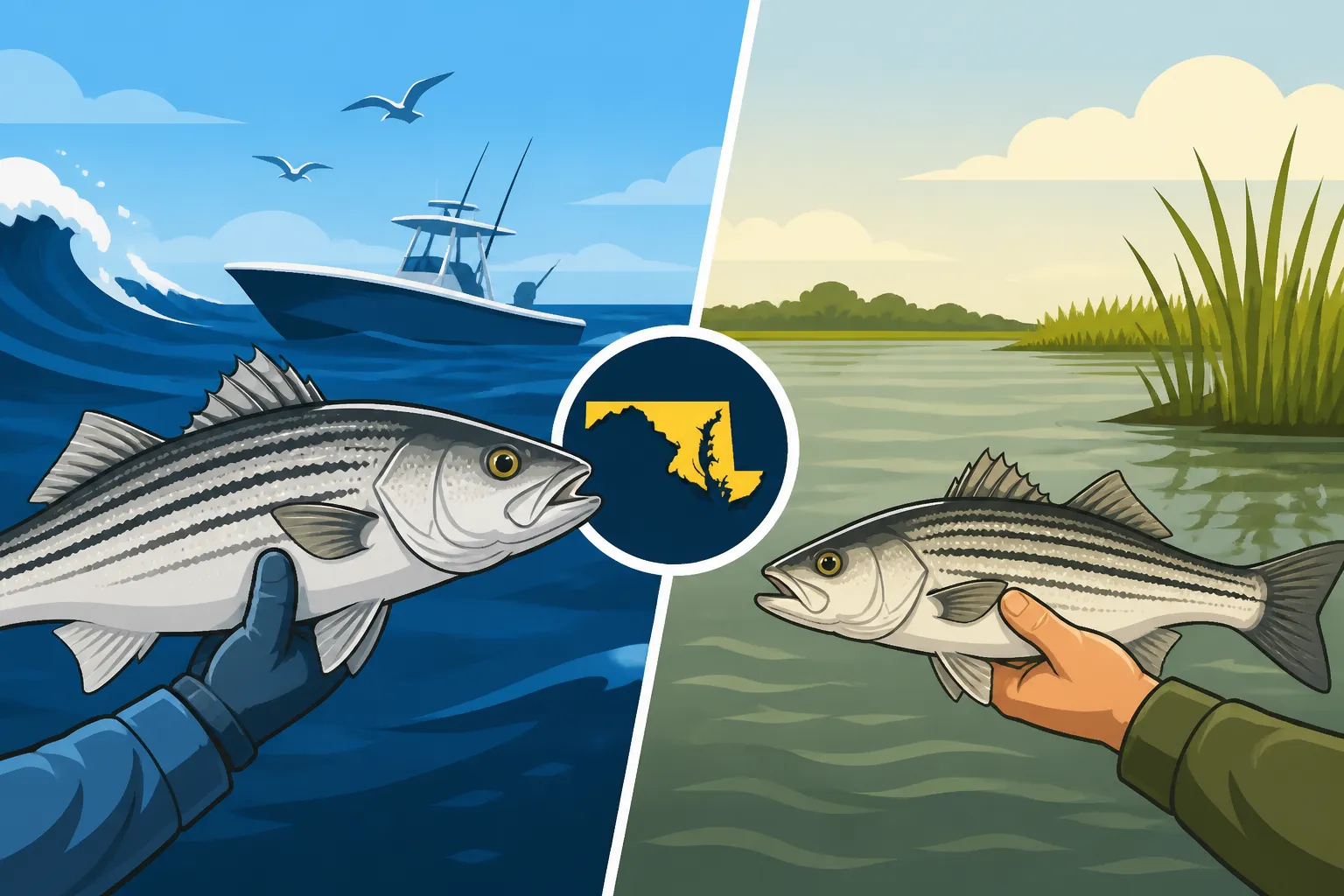
Maryland Striped Bass Minimum Size in the Ocean vs the Bay
It can be incredibly frustrating to be out on the water, eager to land a beautiful striped bass, only to second-guess yourself about whether your catch is legal. With different rules seemingly popping up for every stretch of water, knowing the exact minimum size for striped bass in Maryland's diverse fishing grounds, especially between the wide-open Atlantic and the calmer Chesapeake Bay, feels like navigating a legal minefield. This guide is here to clear up that confusion, explaining why these regulations exist, what they currently are, and how you can confidently stay within the law, no matter where you cast your line.
Understanding Maryland's Striped Bass Regulations
Let's face it, the world of fishing regulations can feel like a constantly shifting puzzle. One day, you hear about a new slot limit; the next, a season closure. For striped bass, Maryland's iconic "rockfish," this complexity is particularly true because their migratory patterns and spawning habits necessitate different management strategies across different bodies of water. It's not just about what size fish you can keep; it's also about understanding why those sizes are in place.
Why Regulations Differ Between Ocean and Bay
The primary reason for differing regulations between the Atlantic Ocean and the Chesapeake Bay boils down to biology and geography. The Chesapeake Bay is the largest estuary in the United States and serves as the most critical spawning and nursery ground for the majority of the Atlantic Coast's striped bass population. Think of it as the striped bass's cradle. These fish travel incredible distances, often from as far north as Maine, to return to the Bay's brackish waters to spawn each spring. This makes the Bay an exceptionally sensitive area for conservation.
Conversely, the Atlantic Ocean, including Maryland's coastal bays and nearshore waters, is primarily a migratory route and feeding ground for adult striped bass. While you can certainly catch them there, the fish caught in the ocean are often larger, older individuals that have already completed their spawning runs or are on their way to do so. They are part of a broader, coast-wide stock managed not just by Maryland, but through interstate cooperation with bodies like the Atlantic States Marine Fisheries Commission (ASMFC). This larger-scale management often results in different size and creel limits, aiming to protect the overall population throughout its entire range, not just within Maryland's specific spawning grounds.
Consider a scenario where you're fishing near Ocean City, reeling in a hefty striper, and your buddy is catching smaller ones up the Bay near Annapolis. It might seem odd that your legal fish might be a different size than theirs. This isn't arbitrary; it's a reflection of these distinct biological roles and management goals. The Bay's rules are often designed to protect the spawning stock and allow juvenile fish to mature, while ocean rules might focus on maintaining a healthy adult population that has already contributed to the next generation.
The Importance of Minimum Size Limits
Minimum size limits are one of the cornerstones of responsible fisheries management, and they're crucial for the long-term health of the striped bass population. The basic idea is simple: by setting a minimum size, we ensure that most fish have the opportunity to reproduce at least once, if not multiple times, before they're harvested. For a species like striped bass, which can live for many years and grow quite large, this is incredibly important.
If anglers were allowed to keep any size fish, there would be a strong incentive to take juvenile fish, potentially depleting future breeding stock. These smaller fish haven't had the chance to contribute to the next generation, and consistently removing them could lead to a rapid decline in the population. A minimum size limit acts as a protective measure, giving those younger fish a fighting chance to mature and spawn.
In many cases, like with Maryland's Chesapeake Bay, you'll hear about "slot limits." This isn't just a minimum; it's a minimum and a maximum size. For example, a "19 to 24-inch slot limit" means you can only keep fish that fall within that specific size range. Fish smaller than 19 inches are too young; fish larger than 24 inches are often the highly productive, older females that are essential for successful spawning. This nuanced approach helps protect both the young fish and the critical breeding stock, allowing for a more sustainable fishery. Understanding why these numbers matter helps us all be better stewards of this incredible resource. For more on this, you can check out our article on the Maryland Rockfish Slot Limit Explained.
Specific Minimum Size Limits for the Chesapeake Bay
Fishing in the Chesapeake Bay is a quintessential Maryland experience, but it comes with its own set of rules, particularly for our beloved striped bass. These regulations are meticulously crafted to protect the Bay's crucial role as a spawning ground. It’s vital to be intimately familiar with them before you even think about dropping a line.
Current Bay Regulations and Common Misconceptions
Maryland's Chesapeake Bay striped bass regulations generally feature a slot limit. This means there's both a minimum and a maximum size for the fish you can keep. Typically, anglers are allowed to keep one striped bass per person per day, with that fish falling within a specific slot, often 19 to 24 inches total length. Total length is measured from the tip of the snout to the tip of the longest lobe of the tail, compressed. This "one fish, 19-24 inch" rule is designed to protect the very young, immature fish, and also the large, highly reproductive females, often referred to as "trophy" fish, that are critical for replenishing the stock.
A common misconception is that if you catch a larger fish, you can just release it and keep the next legal one. While catch-and-release is commendable, during a slot limit, if you've already boated a fish within the legal slot, you cannot then cull it for a larger one if you already possess a legal fish. Your daily limit is one, and that's it. Another frequent misunderstanding revolves around specific seasonal closures. The Bay has various seasonal closures, particularly in the spring during spawning and sometimes in late summer, even for catch and release. For instance, there are specific Maryland Spawning River Closures for Striped Bass that must be respected. It's not just about size, but also about when and where you're fishing. Always consult the Maryland DNR's official guide or website for the most up-to-date information, as these rules are subject to change annually or even mid-season based on stock assessments.
Let's illustrate with an example: you're fishing near the Bay Bridge Pilings for Striped Bass and hook a 17-inch striped bass. You must release it. Later, you catch a 21-inch striper; this fish is within the slot and can be kept. If you then catch a 26-inch striper, you must release it because it's over the maximum slot size. You cannot keep the 26-inch fish and release your 21-inch fish. This is crucial for compliance.
Enforcement and Best Practices in the Bay
Maryland Department of Natural Resources (DNR)执法人员 (law enforcement officers) are regularly patrolling the Chesapeake Bay, and they take these regulations very seriously. They conduct vessel boardings and shore patrols to ensure anglers are complying with size, creel (bag), and season limits. Penalties for violations can be significant, ranging from hefty fines to the forfeiture of fishing gear, and even loss of fishing privileges. We have a dedicated guide on Maryland Fishing License Penalties for Violations that goes into more detail.
To ensure you stay compliant and avoid any unintended trouble, several best practices are highly recommended. First and foremost, carry a reliable measuring device. A rigid ruler or a stick-on measuring tape on your cooler or boat deck is ideal. Flexible cloth tapes can be inaccurate, especially on a squirming fish. Measure quickly and accurately. When a fish is clearly undersized or oversized, handle it minimally and release it immediately, without bringing it fully into the boat if possible. Many anglers find a dehooking tool indispensable for quick, safe releases.
Secondly, stay informed. Regulations can and do change. The Maryland DNR provides annual fishing guides, updates on their website, and often issues alerts for significant changes. Subscribing to their email newsletters or following their social media channels can be a good way to receive timely updates. Remember, ignorance of the law is not an excuse. Familiarizing yourself with the Maryland DNR Fishing and Boating Guide, Explained is a great starting point.
Finally, when in doubt, err on the side of caution. If a fish is borderline, it's always better to release it. The future of striped bass fishing in the Chesapeake Bay depends on all of us respecting and adhering to these vital regulations.
Specific Minimum Size Limits for Maryland Ocean and Coastal Waters
Moving from the relatively protected waters of the Chesapeake Bay to the dynamic environment of the Atlantic Ocean and its coastal bays like the Isle of Wight Bay or Sinepuxent Bay, the rules for striped bass change. While it's the same species, the distinct ecosystem and migratory patterns offshore necessitate a different management approach, typically falling under broader regional guidelines.
Ocean City and Atlantic Coast Regulations
For recreational anglers fishing in Maryland's Atlantic Ocean and its coastal bays (out to three nautical miles), the striped bass regulations are generally aligned with the Atlantic States Marine Fisheries Commission (ASMFC) coast-wide management plan. This means the rules can be influenced by federal and inter-state agreements, making them distinct from the Chesapeake Bay's specific measures. Typically, the Atlantic coast will have a different slot limit or minimum size.
Historically, ocean regulations have been set to protect different components of the striped bass stock compared to the Bay. While the Bay focuses on spawning, the ocean rules often target the broader migratory population, aiming to allow more fish to reach maturity and contribute to the overall stock. A common regulation for the ocean has been a minimum size that is often larger than the Bay's slot limit, for instance, a 28-inch minimum length with a maximum of less than 31 inches, allowing one fish per angler per day. Again, this is an example, and the exact numbers, including seasons and bag limits, can fluctuate annually.
It's crucial to understand that these rules apply to true ocean waters and coastal bays like those around Ocean City. If you're fishing from a pier in Ocean City or surf fishing at Assateague Island, these are the regulations you need to follow. Always verify the current year's regulations with the Maryland DNR, as well as any federal waters beyond three miles, which might have even stricter rules. The article on Maryland Ocean Fishing Rules Differ From Bay Rules? offers more context on these distinctions.
Understanding Federal vs. State Waters
The distinction between state and federal waters is a critical, though often overlooked, aspect of ocean fishing regulations, especially when it comes to migratory species like striped bass. Maryland's state waters generally extend three nautical miles offshore from the coastline. Within this zone, Maryland DNR regulations typically apply, even though they are often harmonized with ASMFC guidelines.
Beyond three nautical miles, you enter federal waters, sometimes referred to as the Exclusive Economic Zone (EEZ). In these waters, federal fisheries management bodies, such as the Mid-Atlantic Fishery Management Council (MAFMC) and the National Marine Fisheries Service (NMFS), have jurisdiction. For striped bass, federal regulations typically prohibit harvest entirely in the EEZ, meaning you cannot keep striped bass caught more than three miles offshore. This rule is designed to provide an additional layer of protection for the species as they undertake their extensive migrations.
So, if you're on an offshore charter boat out of Ocean City, heading far out to target tuna or marlin, and happen to hook a striped bass beyond that three-mile mark, it must be released. The captain of your Maryland Chesapeake Bay Fishing Charters, What to Expect or Ocean City Maryland Offshore Charter Fishing will be well-versed in these boundaries and rules, but it's always good for anglers to be aware. This layered approach to management across state and federal jurisdictions highlights the complexity of protecting a species that moves so freely across vast stretches of ocean.
Practical Tips for Anglers to Stay Compliant
Navigating fishing regulations can feel overwhelming, but with a few practical habits and the right gear, staying compliant becomes second nature. It's not just about avoiding fines; it's about contributing to the sustainability of the fishery for future generations.
Essential Gear for Measuring and Handling
Having the right tools on hand is half the battle when it comes to adhering to size limits. A reliable measuring device is paramount. Forget the flimsy tape measure you use for home projects; you need something that can withstand the elements and provide accurate measurements on a boat or slippery bank.
- Rigid Measuring Boards/Rulers: These are by far the best option. Many tackle shops, especially local ones like Angler's Sport Center in Annapolis or Ocean City Fishing Center, will have plastic or aluminum measuring boards. You can also find them online through retailers like Amazon. They usually have a fixed end to butt the fish's snout against, ensuring an accurate "total length" measurement.
- Stick-on Measuring Tapes: Another excellent option for boats or coolers. These waterproof tapes adhere directly to a flat surface, providing a quick and easy reference point.
- Dehooking Tools: While not directly for measuring, a good dehooker is essential for safely releasing undersized or oversized fish. Minimize handling time and physical contact with the fish, especially if you're practicing catch and release during closed seasons or for fish outside the slot. Long-nose pliers or specialized dehookers prevent deep hook sets from becoming a death sentence for a released fish.
- Fish Grips: These can help you safely secure a fish for a quick measure and photo without putting your hands in its gills or mouth, further reducing stress on the fish.
Having these items readily accessible ensures that when you land a fish, you can quickly and accurately determine its legal status, minimizing stress to the fish and maximizing your compliance.
Staying Updated on Regulation Changes
This might be the most crucial tip: fishing regulations are not static. They change. They change due to scientific assessments of fish stocks, environmental factors, and management decisions by state and interstate bodies. What was legal last year might not be this year, and what's legal in the spring might change for the fall. Relying on old knowledge or hearsay from a buddy can lead to costly mistakes. Our article on How Often Maryland Updates Its Fishing Regulations delves deeper into this.
Here’s how you can stay on top of the latest rules:
- Maryland DNR Website: This is your authoritative source. The Maryland Department of Natural Resources (DNR) website (dnr.maryland.gov) hosts the most current regulations, often updated in real-time. Bookmark the fishing regulations page.
- DNR Annual Fishing Guide: Pick up a physical copy of the Maryland Fishing and Boating Guide. These are usually available at tackle shops, DNR offices, and sporting goods stores at the start of each year. While convenient, always cross-reference with the website for any mid-year amendments.
- Email Newsletters and Social Media: The DNR often sends out email alerts for significant changes. Sign up for their newsletters. Follow their official social media channels, where updates are frequently posted.
- Local Tackle Shops: Proprietors of local bait and tackle shops are often the first to know about changes and can offer practical advice on how to interpret new rules. They are a valuable resource in communities like Kent Island or Solomons Island.
- Fishing Apps: There are various fishing apps available that consolidate regulations. While helpful, always ensure they are pulling directly from official sources like the Maryland DNR to avoid outdated information.
Making it a habit to check the current regulations before every fishing trip, especially if you haven't been out in a while or are visiting a new area like Maryland's Deep Creek Lake Fishing Guide, is the best way to ensure you're always fishing legally and responsibly.
Comparing Maryland Striped Bass Minimum Size Limits
To help clarify the differences at a glance, here's a general comparison of typical recreational striped bass minimum size limits in Maryland's Chesapeake Bay and Atlantic Ocean/Coastal Bays. Please remember these are general examples and highly subject to change. Always check current regulations from the Maryland DNR website or official guide before fishing.
| Feature | Chesapeake Bay (Recreational) | Atlantic Ocean & Coastal Bays (Recreational) |
|---|---|---|
| Primary Focus | Spawning stock and juvenile protection | Migratory adult stock protection |
| Typical Limit | Slot Limit (e.g., 19-24 inches) | Minimum Size (e.g., 28 to < 31 inches) |
| Fish Count | 1 fish per person per day (often) | 1 fish per person per day (often) |
| Jurisdiction | Maryland DNR (state waters) | Maryland DNR (state waters) / ASMFC (coast-wide) |
| Federal Waters | Not applicable | No harvest beyond 3 nautical miles offshore (EEZ) |
| Key Seasonality | Spawning closures common (spring) & summer closures | Seasonality may vary by year/federal guidance |
This table provides a quick visual, but again, consider it a snapshot. Regulations on Maryland Striped Bass Season and Rockfish Rules are dynamic and can be adjusted multiple times within a year.
Disclaimer
This article is for general informational purposes only and does not constitute professional advice. Laws, prices and regulations vary by location and change over time. Consult a qualified professional for guidance on your specific situation.